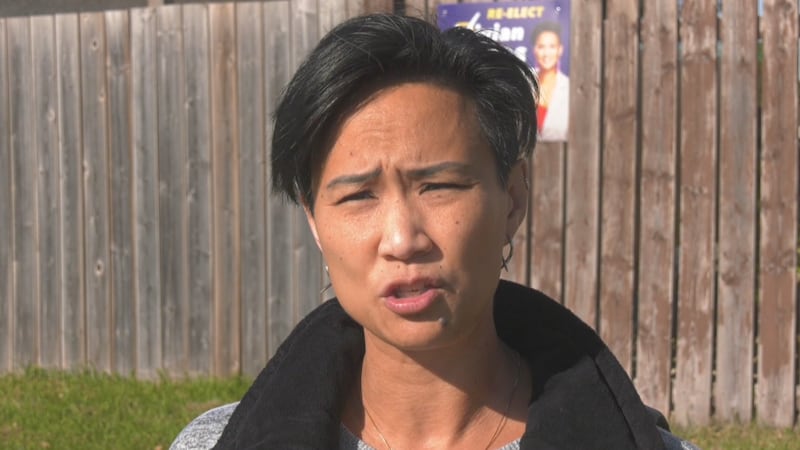
Deborah Young dialled her boss as she watched the road in northwest Calgary disappear beneath water. Next to it, a battered, half-submerged vehicle was abandoned. Nearby, a truck was pinned to a bridge pillar, former occupants now atop it. And there were others. Young, a primary care paramedic and Calgary EMS operations supervisor, had driven over the spot where the hole now was five, maybe 10 minutes prior. She was called to turn around: lots of water—go check it out. The call didn’t make sense. “I thought about it, too,” she said. “I was like, ‘Did I hit a big bump there? Was there anything?’ “There was nothing.” On the night of Dec. 30, 2025, Calgary’s aged, ailing Bearspaw feeder main ruptured a second time. The force of it sent a vehicle into the air. The water quickly rose to about the height of the road’s median and the windows of multiple vehicles. Young told her boss on the line, “This is an actual river—there are rapids.” “There were whitecaps,” she said. “My first thought was, ‘If this median gives out, am I getting swept away?’” ‘Just chaos’ Not long before, on the other side of the wet, Morgan Yanco pulled up to what he described as “just chaos.” The water was rising fast, and a row of vehicles was already stalled. Yanco, an advanced care paramedic and Tactical Emergency Medical Support member, watched as people tried to push their cars and trucks. And then as they climbed atop them. “There are a lot of things you anticipate at the end of December,” he said. “A water rescue call in Bowness on 16th Avenue isn’t something you’re anticipating.” The main break occurred near the Sarcee Trail/16 Avenue N.W. interchange, a few blocks from the last one in summer 2024. Seemingly endless water flowed off the road, taking over pathways and continuing into the park. The 911 calls followed quickly and in quantity. One vehicle was floating down the road. A family with special-needs children was trapped inside another. Someone was navigating the crisis on a broken leg. ‘Making decisions out of self-preservation’ Of the moves available to the stranded, Yanco said the one they chose was “safest, maybe.” Mounting vehicles was the best chance to stay dry on a cold, now-wet night. It eliminated potential for entrapment. And increased visibility while they awaited saving. “You’re stuck (in rising water) in the middle of 16th Avenue,” Yanco said. “I don’t think driver training covers what to do there. “You’re making decisions out of self-preservation.” Young said she’s thought a lot about what she might’ve done. “With the sheer amount of water,” she said, “they probably did the right thing. “Everything gets pushed against a pillar in a river, and that’s how people get trapped and drown.” People’s panic varied wildly. Yanco said some were “incredibly panicked.” Others were “more concerned about making sure they got their stuff out of their cars.” He said in an emergency, everyone reacts differently. Some felt it in the moment, and probably it clicked for others after they’d made it home. A plan to get them there formed quickly but didn’t feel like it, Yanco said. He said, “On scenes like this, time has a way of standing still.” Police shuttered many a road over an area of size and put a helicopter overhead to light up the secured perimeter. Somewhere, city crews getting better-versed in water woe began work to turn off the tap. And fire department rescue teams suited up to set about saving more than a dozen people. Calgary EMS had multiple units waiting on worst-case scenarios. Ambulances had their back bays warmed and blankets piled. Yanco said wet, cold and potentially injured “is not a good combination.” Looking across the water at the tops of vehicles and the people huddled on them, he said, maybe you want to rush to help them. But you can’t. “Water rescues aren’t our place,” he said. “We’re not trained for that—we don’t have any expertise in that. “It’s far too dangerous for us to go in.” EMS’s job that night was to wait for patients to be brought to them, Yanco said, then “triage, treat and transport accordingly.” ‘Looked like it was going to be a lot worse’ Firefighters paddled from “shore” to vehicle and back again, over and over, to save the stranded. At a pace of about two to three minutes a person, everyone was brought safely back. No fatalities; no one injured. Young said she was surprised no one had to be taken to hospital. And also relieved. “It looked like it was going to be a lot worse than it ended up being,” she said. “I was expecting bodies when I arrived and saw the amount of water.” Young spoke briefly to the occupant of that first vehicle—the one that left the ground. He told her he got out after it landed and took refuge across the street. Most of his escape was running; he might’ve mentioned swimming some of it. Most everyone else was able to stay dry. What Calgary EMS received, Yanco said, was “a lot of very emotional people that needed a lot of reassurance.” “They’re just wondering what happened,” he said, “and it’s hard to tell people in the moment, ‘I don’t know what happened; I don’t know what caused this.’ “But that’s the honest answer.” ‘They didn’t have anyone to come grab them’ Calgary EMS left the wet with the understanding they’d be called back if needed. That call fortunately never came. When they cleared, they took one stranded family with them. “I’m fairly certain there was a family that lives nearby who our crew gave a courtesy ride home to,” Young said. “They didn’t have anyone to come grab them.” After the first main break, a local state of emergency was declared. Water use restrictions were put in place. The city carried out 29 repairs along the Bearspaw line, with the work completed by November 2024. A little more than a year later, after the second break, the emergency operations centre doors opened again. And water use restrictions were put in place again. This time, repairs took weeks, not months, though additional work to maintain and ultimately replace the line is ongoing. EMS was on alert while repairs were carried out. Yanco said there was “the foresight to understand that in the vicinity of that area, there was a large group of people that may or may not need to be evacuated should anything happen.” “(The aftermath) was something that was very strategically planned,” he said, “and we brought down extra resources from Edmonton to support that.” EMS debriefed after the break. “Throughout our careers, we all have various experiences,” Yanco said, “but I don’t think anyone who was there that night had been in that type of situation before.”