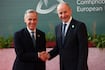
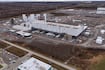
DUBLIN - Prime Minister Mark Carney is defending his government’s rhetoric around the sale of the Stellantis auto plant in Brampton, Ont., despite CTV News confirming through multiple sources that the federal government was aware of the deal to sell the plant. Speaking in Dublin at the European Political Community summit on Thursday, Carney said the deal between Roshel, a Canadian armoured-vehicle manufacturer, and Stellantis is only a partial solution for autoworkers. He stood by his assertion that Stellantis had “betrayed” Canadian autoworkers. “The betrayal is not fulfilling all the obligations for all the workers. That’s their responsibility,” Carney said. “That’s the responsibility they made multiple times, including in the battery deal that they signed with the government. We will pursue all of this. A partial solution is a step it is not a global solution. That is a betrayal.” Asked whether his government was aware of the Roshel deal to buy the plant, Carney did not directly answer. He also said the government would continue to challenge the Stellantis sale, arguing the company has not lived up to various agreements signed with the provincial and federal governments. Industry Minister Melanie Joly’s office said the minister acted only as a mediator between the company and the union and was never involved in approving the sale to Roshel. “The minister had no part in negotiating with Stellantis or Roshel on the deal,” Mathis Denis, a spokesperson for Joly’s office, told The Canadian Press. “The minister was in a conflict resolution (role) between Stellantis and the union. That’s it.” But lobby registry records show both Stellantis and Roshel held high-level meetings with government officials in recent months, including in both cases with senior staff in Joly’s office. Carney also left open the possibility of attracting additional Chinese auto investment to Canada. Ontario Premier Doug Ford wrote to Carney earlier this week urging him to oppose allowing Chinese companies to assemble “kit cars” in Ontario, arguing it would undermine the province’s autoworkers. A Chinese EV kit is essentially an electric vehicle manufactured largely in China, then shipped to another country — such as Canada — in pieces to be assembled into a finished car. Carney did not directly address Ford’s letter in his brief remarks to reporters, but his office told CTV News on Wednesday that the federal government does not support kit car production. “The extent to which there is Chinese investment depends on a variety of factors. It will be one of the discussions with President Xi. It is also part of our ongoing discussions with the United States,” Carney said. CTV News reported Tuesday that the federal government was actively and closely involved in discussions that ultimately led to the agreement to sell the Stellantis assembly plant to Roshel. The sources said the federal government ultimately did not stand in the way of the deal. The Stellantis plant has been idle since 2023, with more than 2,200 workers on lay-off pay. In 2022, the federal government committed up to $529 million to Stellantis to retool both its plants in Brampton and Windsor, Ont. Records show $222 million had been paid out as of March 2025, however, no breakdown was provided to detail how much went to each plant. In a statement shared Tuesday, Stellantis said it has offered to “voluntarily return the government support received for Brampton Assembly’s original retooling plan.” Stellantis spokesperson LouAnn Gosselin did not disclose how much money that was. Three sources said it amounts to $24 million for the Brampton plant. Joly is expected to meet with Unifor, Stellantis and representatives with the Ontario government in Toronto on Thursday. With files from CTV News’ Marieke Walsh and Vassy Kapelos