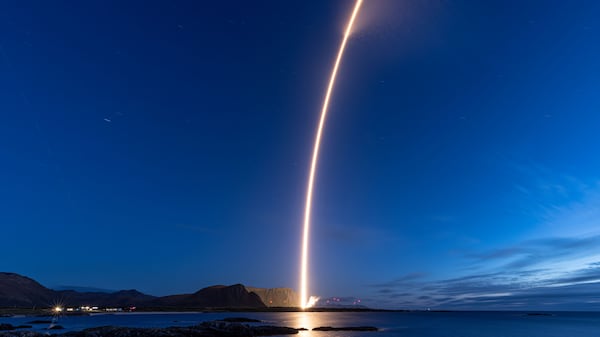
As the world prepares to watch humanity return to deep space for the first time in more than half a century, students and professors at the University of Calgary say the launch of Artemis II represents far more than a technological milestone. It’s a moment they say could redefine how humanity explores space and who gets to be part of that journey. The mission, set to launch Wednesday from the Kennedy Space Centre in Florida, will send four astronauts on a roughly 10-day journey around the Moon and back. The launch is scheduled for 4:24 MST, marking the first crewed mission beyond low-Earth orbit since the Apollo era. Among the crew is Jeremy Hansen, who will become the first Canadian and the first non-American to travel into deep space. For many in Calgary, that connection is deeply personal. At a watch party hosted on campus, University of Calgary physics and astronomy professor Eric Donovan said the significance of the launch is difficult to overstate. “This is 54 years in the making,” he said. “The last time people went away from the Earth in this way was 1972 for Apollo 17.” Donovan said the mission is not just a return to the Moon, but the beginning of a new era. “This is meant to be the beginning of opening up space in a fundamentally different way, creating the Moon as a platform for human activity for decades to come and setting the stage for going to Mars and beyond.” Part of that future, he said, hinges on what scientists may find at the Moon’s south pole, including the possible presence of frozen water in permanently shadowed craters. “If you can set up a base near a source of water, then you have a source of fuel, you have a source of drinking water and a source of fuel.” Donavan added that the inclusion of a Canadian astronaut also underscores the global nature of modern space exploration. “The fact that they’ve given one of the four slots for the astronauts to a Canadian is huge and it really speaks to how the U.S. views Canada as a partner in the space game.” Canada’s moment in deep space The mission is a milestone not only for NASA but for Canada’s space program — with strong ties to Calgary. In a message shared ahead of the launch, Jeremy Hansen called it “an honour” to represent the country and thanked those who helped make the mission possible including fellow Canadian astronaut Jenni Gibbons, a Calgary native and his backup crewmate. “[She] has done a tremendous job as my backup, but also in helping to define training and processes for future lunar missions,” Hansen said. Gibbons has undergone the same rigorous training as Hansen, highlighting the depth of Canadian expertise contributing to the mission and adding a local layer of pride for those watching in Calgary. Hansen also credited “thousands of Canadians” whose work has contributed to the mission, calling Canada “a trusted and reliable partner in space.” “My hope is that Canadians everywhere come together to watch this mission unfold and that young Canadians see what’s possible when we dream big.” That message resonates strongly with students watching from Calgary, many of whom see both Hansen and Gibbons as proof that a path from Canada, and even their own city, to deep space is possible. Inspiring the next generation For University of Calgary graduate students, Artemis II is the first time space exploration feels immediate and real. “My generation really just grew up as going to the Moon was something that people older than us did,” said Larson Scullion, a PhD student in space physics. “So, it’s very cool to see that it’s something we’re still doing and now my generation will finally have memories of watching a launch to the Moon.” Emily Knight, a geomatics engineering graduate student, described the moment as almost surreal. For students immersed in research like her, the mission also highlights how their work connects to something larger. “It’s just incredible to both see the technological advancements and what they’re continuing to push to do.” “These are the moments that we push for and it’s so fun to watch how we’re innovating and how even these innovations build into a bigger picture and our understanding of space. Being able to feel like you have an impact is amazing.” Christian Keenan, another graduate student in space physics, said seeing a Canadian astronaut on board also makes the dream feel more attainable. “It’s my dream one day to go to the moon,” he said. “So, it just really makes it seem like a more realistic goal and a little more in reach than it used to be.” Students also point to the mission’s diverse crew as an important step forward — particularly for women in science. Mission specialist, Christina Koch is one of the American astronauts on the Artemis II mission. She holds the record for the longest single spaceflight by a woman, spending 328 consecutive days aboard the International Space Station (ISS) from March 14, 2019, to February 6, 2020. “It’s just so inspiring,” Knight said. “There’s still struggles with being a woman in engineering but being able to see people push through that glass ceiling, it makes it feel like that barrier doesn’t exist quite as much.” Solveig Thompson, an astrophysics graduate student, echoed that sentiment. “Little girls can really see female astronauts are going to the Moon now and it helps normalize what was once seen as out of reach.” Echoes of Apollo and a new perspective For Donovan, the emotional weight of Artemis II is tied to the legacy of the Apollo missions — particularly the famous “Earthrise” photograph taken during Apollo 8. “People attribute that to having spawned the global environmental movement, seeing the Earth in a fundamentally different way,” he said. He believes Artemis II could offer a similar moment for a new generation. “If you think about what these people are doing and the audacity of it, it’s worth everybody taking a minute or two, sending good wishes, good thoughts, and good feelings towards these people.” As millions around the world prepare to watch the launch, that sense of shared anticipation is already being felt in Calgary classrooms and labs. “It’s inspirational,” Donovan said. And for students gathered to witness history unfold, the mission represents more than a return to the Moon. “It will mean the world to me,” Keenan said. “I don’t think I’ll have words to explain it.”