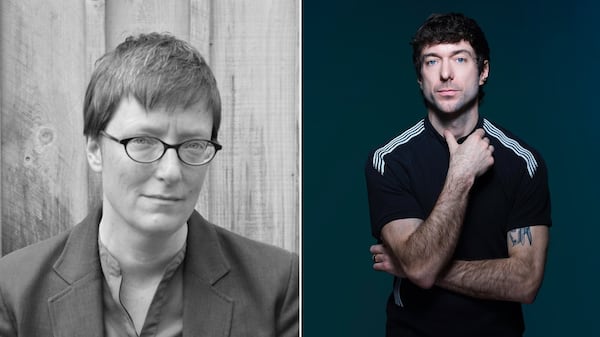
Contemporary artist Paul Brain is using lessons from his own traumatic brain injury to help children explore their creativity through a program called Neuro Art. Brain runs his classes out of the Chinese Cultural Centre, teaching students to paint from their thoughts rather than what they see in front of them. He doesn’t use models or references, instead encouraging children aged two to 17 to paint what they see in their mind’s eye. “We’re not looking at references at all,” he said. “So we are trying to capture what the brain really, truly finds and is already there. So with that capture, we go straight from the brain to the painting. There’s nothing hiding between and after that.” Brain developed a deeper understanding of his own brain after suffering an intracerebral hemorrhage in 2021 at the age of 33. A portion of the left side of his brain was removed, and he had to relearn how to talk, read and write. “Some brain fans might know that the left brain captures a lot from what we learn from school experiences,” he said. “And imagine a chunk of that is gone from this side because I got a stroke from my brain.” Brain says his disability has given him a new understanding of how the brain can rewire itself to allow people to function. “We really believe in neuroplasticity,” he said. “It doesn’t matter what age you are, the brain always reconstructs into the way that it will function in different ways, so it’s an exciting journey into exploration.” Students in the Neuro Art class say their work isn’t judged, allowing them to explore whatever comes to mind. Thirteen-year-old Minette Zeng enjoys working with clay and sketching creatures she’s seen in cartoons and video games. “This class helps me because other people may like to judge you for what you may draw,” she said. “But here you don’t have to think about that at all. You can just do whatever you like and just be creative and just draw and you don’t have to think about other people.” Zeng says it was a little challenging at first when she was told to draw from memory rather than look at an object. “At first Paul just makes us draw what we think of what an image would be like, animals, pictures, whatever,” she said. “We have to draw it first, see how our brain would think of it and then after a bit, yeah, we start to like it and then just continue on from there because it’s a fun feeling.” Felix Chan’s son Calix is just two and a half years old, but Chan says the Neuro Art class is helping him better understand how his son is feeling and what he’s thinking. “Because he’s my first child, I have no idea how to deal with kids, right? So that’s why through his artwork, he can show me what he’s thinking inside his brain,” he said. “At home or day care they’re only training him, maybe just line drawing, practicing alphabets, singing a song, but I don’t know if he likes it. So here I can know his emotion — if he’s happy or sad — the colour actually means something to him, so that’s why I like the artwork.” Brain says his students rarely want to take a break when creating art from their minds because they don’t want to lose the image they have before completing their pieces. “It’s been a very good capture with different young brains, young art stars who are coming alive,” he said. “And it’s a fantastic experience and good feeling.”