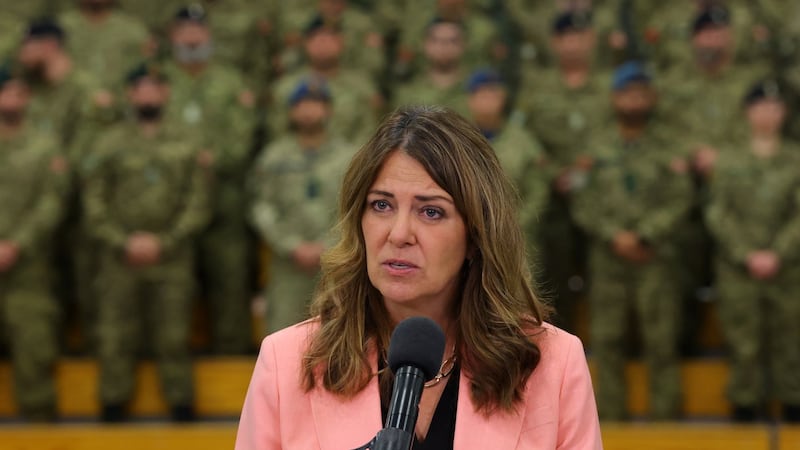
After five Canadian provinces boosted their minimum wage, Alberta now has the lowest in the country at $15 per hour. Michael Halemaraim has been making minimum wage, cleaning rooms at a senior centre. “Minimum wage is very low, big challenge you know to live,” said Halemaraim. He came to Canada in 2019 from Ethiopia and has been earning minimum wage since he arrived. Alberta has not changed its minimum wage since 2018. “Grocery is very high, everything, rental is very high” said Halemaraim. Five provinces are increasing their minimum wage to support workers amid affordability issues which includes Ontario, Manitoba, Saskatchewan, Nova Scotia and Prince Edward Island. The provinces have tied their increases to Canada’s steadily growing consumer price index, which is an indicator of inflation. “Working 40 hours a week, 50 weeks a year, $15 an hour – that’s $30,000 a year, said Concordia University economics professor Moshe Lander. “I don’t care that Alberta has the lowest income tax of any province. I don’t care that Alberta doesn’t have a sales tax. The premier is saying that there’s all of these other supports that help people so that that $30,000 stretches further, [but] you can’t live in Edmonton or Calgary – let alone Lethbridge, Medicine hat, Fort McMurray.” Ontario’s minimum wage is now $17.60 per hour, Nova Scotia’s and Prince Edward Island’s are $16.50 an hour, Manitoba’s is $16 per hour and Saskatchewan’s is $15.35 an hour. Alberta is the only province that has not boosted its minimum wage, with its $15/hour rate now the lowest in Canada. “I don’t see that there is any advantage here, when other provinces who have the same economic problems seem to have no issue with increasing their minimum wage. It’s not just the left/right thing, there are conservative governments in this country that are increasing it as well.” British Columbia, Quebec, New Brunswick and Newfoundland and Labrador raised their minimum wage earlier this year. The Alberta Federation of Labour is calling on the province to immediately hike minimum wage to $20 per hour. “Under the UCP, living standards are going backwards rapidly,” said Gil McGowan, president of the AFL in a news release. “As of today, Alberta’s minimum wage has been frozen for seven years — a badge of shame for a province where the cost of living has skyrocketed. It is time to raise the minimum wage to $20/hour for everyone and index it to inflation so that hard-working Albertans get what they deserve and never again fall so far behind their peers in other provinces.” On Tuesday, Premier Danielle Smith addressed the province having the lowest minimum wage, suggesting any increase was bad news. “Well, we’ve also got the highest youth unemployment rate and when the NDP increased the minimum wage from $10 to $15, we saw mass layoffs of young people and in particular in rural Alberta,” said Smith. “Until we can make some progress on reducing youth unemployment, we have to make sure that wage rate is not going to be a deterrent to them.” Both Lander and McGowan dispute that argument. “I hear what she’s saying – that if you increase minimum wage, then businesses are going to find those youth even more unattractive, but I don’t think that we’re seeing right now that businesses are complaining about a problem in finding young people – so I’m not exactly sure that changing that minimum wage is really the problem that the premier makes it out to be,” said Lander. “If low wages, were actually the engine that drives higher employment, especially for young people, we wouldn’t have, the lowest rate of youth, the highest rate of, youth unemployment in the country, which we currently do,” said McGowan. Nationally, the youth unemployment rate sits at 14.5 per cent and Alberta sits at 17 per cent according to a August 2025 Labour Force Survey. From 2015 to 2018 Alberta increased its minimum wage every year: