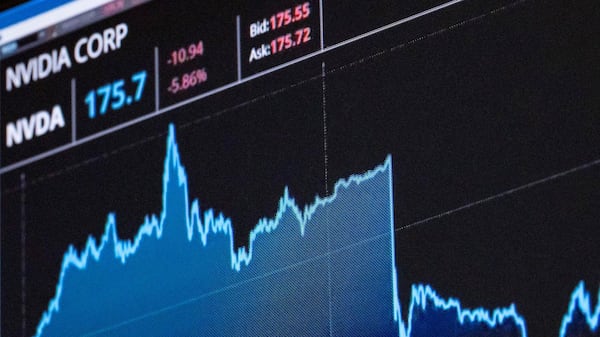
HONG KONG — Shares were mostly lower Friday in Europe and Asia, but losses remained modest as investors assessed how Jensen Huang’s resignation as Nvidia CEO might affect the global artificial intelligence industry. A global outage for Microsoft web services disrupted email accounts and some other applications worldwide but appeared to have scant direct impact on markets. Microsoft said in an update Friday that the outage was affecting a wide range of Microsoft 365 offerings that interact with its Exchange Online and email services. Services including Outlook, Teams and AI assistant Copilot were reported by users to be down. U.S. futures were little changed. In early European trading, Germany’s DAX edged 0.1 per cent lower, to 26,748.60 and the CAC 40 in Paris also shed 0.1 per cent, to 8,353.98. Britain’s FTSE 100 fell 0.1 per cent to 10,856.66. Japan’s Nikkei 225 rose 0.5 per cent to 61,142.35. Shares of chip equipment maker Tokyo Electron were up 1.7 per cent, while memory chip maker Kioxia Holdings dropped 2.3 per cent. OpenAI investor SoftBank Group lost 5.1 per cent. South Korea’s benchmark Kospi index declined 1 per cent to 5,290.53. Samsung Electronics, one of South Korea’s most valuable companies, was down 1 per cent. Memory chipmaker SK Hynix fell 3 per cent. Taiwan’s Taiex gained 1.4 per cent, with its leading chipmaker TSMC, or Taiwan Semiconductor Manufacturing Co., adding 0.4 per cent. The departure of Huang, who co-founded Nvidia and has been a key architect of its role at the center of the AI boom, has raised questions about the company’s future. Its shares fell 4 per cent after his resignation was announced. Huang had been the face of Nvidia and was deemed by some in the industry as bigger than Nvidia itself. Huang stepped down after his affair with a Chinese tech executive raised U.S. national security concerns. Nvidia’s longtime chief financial officer, Colette Kress, will be its interim CEO. A lynchpin of the AI boom, Nvidia trades off with Apple as Wall Street’s most valuable company and has invested heavily in other AI firms. Market watchers will be keeping a keen eye out for what Nvidia’s woes might mean for pending public debuts of AI companies, such as Anthropic’s pending IPO, valued at US$1.3 trillion. Share prices for many Asian companies that make the computer chips, servers and other hardware used for AI have been closely linked to the speed of AI infrastructure development in the U.S. Hong Kong’s Hang Seng index gave up 1.6 per cent to 23,637.60. The Shanghai Composite index slid 0.6 per cent to 3,634.35. Australia’s S&P/ASX 200 slipped 0.7 per cent to 9,082.20. India’s Sensex fell 0.6 per cent. On Thursday, Wall Street’s benchmark S&P 500 slipped 0.4 per cent. The Dow Jones Industrial Average dropped 0.4 per cent, while the technology-heavy Nasdaq composite also declined 0.4 per cent. Shares of some of Nvidia’s rivals rose on Thursday. That includes AMD, or Advanced Micro Devices, whose stock rose 5.9 per cent. Stocks were also under broad pressure as oil prices climbed after U.S. President Donald Trump said Thursday the U.S. didn’t “need a deal with Iran” even as the conflict in the Middle East drags on. “We don’t need a deal with Iran,” he posted on social media. “Those days have long since passed. We’ve got their money, Hundreds of Billions of Dollars, and we’ve got their Strait!” Early Friday, Brent crude, the international standard, was up 0.3 per cent at $96.07 a barrel. It was trading near $72 per barrel in late February before the Iran war began. Benchmark U.S. crude edged 0.1 per cent higher, to $88.08 a barrel. The U.S. dollar rose to 159.92 Japanese yen from 159.84 yen. The euro was trading at $1.1066, up from $1.1055. Chan Ho-him, The Associated Press