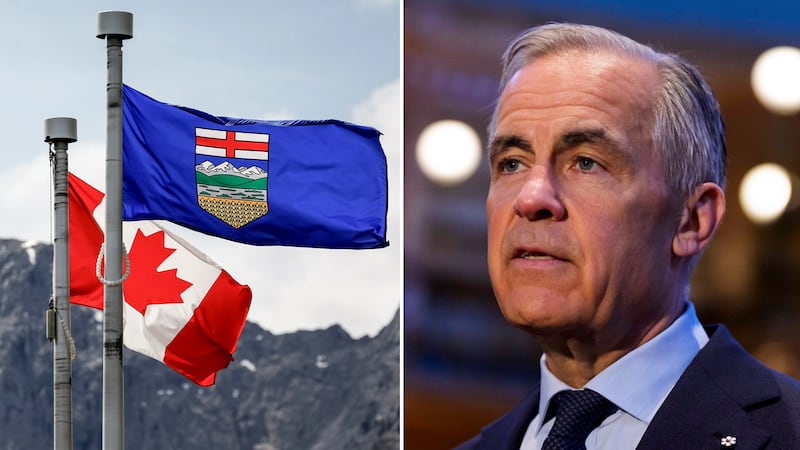
For the third time since the writ was dropped, Mark Carney detoured from the campaign trail this week to deal with Donald Trump’s trade war. But unlike the first two times, the prime minister did not outline any action that the government would take to respond to the changing nature of the tariffs. Earlier this week, the Trump administration paused global reciprocal tariffs against dozens of countries for 90 days, an announcement that didn’t change the levies the U.S. is currently imposing on Canadian automobiles, steel and aluminum. After meeting with his Canada-U.S. cabinet council, Carney warned there are signs the global economy is slowing, and said the government would renegotiate a new trade deal days after the election. “We left instructions for officials to ensure the next government, whichever government Canadians choose, will be in the best position for negotiations with the United States, which the president and I have agreed will begin at the start of May,” Carney said in remarks to reporters gathered outside the cabinet conference room. The prime minister left without taking questions, just as news of a temporary pause in production at a General Motors plant in Ingersoll, Ont., began to break. The company said that sales of the electric van assembled at the plant had slumped and that approximately 500 people would face layoffs. Later in a statement posted on X, the platform formerly called Twitter, Carney the candidate called the job losses “painful news for autoworkers in Ingersoll.” He promised to fight to “defend our auto sector, protect our workers and build our supply chains in Canada,” and said the government had made it easier for affected workers to access support. NDP Leader Jagmeet Singh also issued a statement about the “devastating” layoffs at the GM plant. “Hundreds of working people are worrying about how they’ll keep food on the table, and what their future looks like. It’s time to put workers and jobs at the heart of Canada’s tariff fightback plan.” The only leader close to the impact zone was Pierre Poilievre, who has been campaigning in southwest Ontario for the past three days. “Nobody can control what President Trump does but that’s exactly the point. Mark Carney is running on the false promise that he can somehow magically handle Trump or control him in doing what he wants – when it’s precisely the opposite that is the case,” said the Conservative leader in front of a rallying crowd in Windsor on Friday evening. The Stellantis plant in Windsor was the first assembly line in Canada to halt production after Trump announced his tariffs. All three leaders have now visited the city on the south side of the Detroit River. And residents are paying close attention to the election. Each autoworker job in Windsor impacts six others. “As an autoworker you feel helpless because things aren’t in your control,” said Richard Bayley, who works at Stellantis and is also the co-owner of the restaurant Sawyer’s Craft BBQ. He hasn’t made up his mind yet on who to vote for, but he knows what characteristics he wants in a prime minister. “It’s got to be someone who makes Canadian workers a priority. Being dependent on other countries, even the ones right across the border – they may be great trading partners but we’re not as self-sufficient as we can be. We have so much land, so much resources, such great people in our country…the next leader should focus on keeping jobs here and making sure we’re more self-reliant,” Bayley said. Meanwhile, server Hannah Schneider has made up her mind. She’s a graduate student studying at the University of Windsor. Trump’s threat to Canadian sovereignty has forced her to make a counter-intuitive decision. “I’m usually a devout NDPer. I really prioritize social services and lifting up people who are struggling and marginalized people are usually at the forefront of what I think about during voting – but federally it feels I have to vote strategically,” Schneider explains. “It’s likely I will have to vote for Mark Carney.” For Schneider, voting strategically feels like a “compromise to democracy over all,” but the social work grad student says Canada needs a “counter balance” – not just to Donald Trump, but to hold back the possibility of a Conservative win.