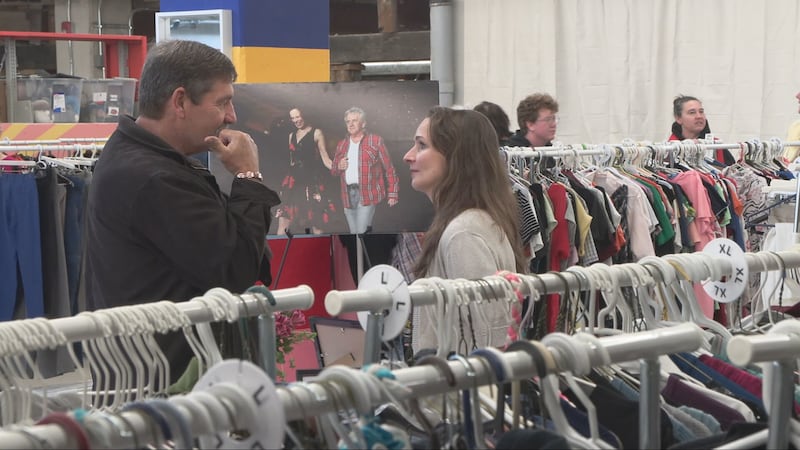
WASHINGTON - When the owners of online clothing shop Princess Awesome heard about Canadian counter-tariffs, their first thought was “oh no, more chaos,” said co-founder Eva St. Clair. “More” is a key word. St. Clair and business partner Rebecca Melsky say they have been through many twists and turns in the tariff war over the past year and a half. They even took U.S. President Donald Trump to court over the International Emergency Economic Powers Act (IEEPA) tariffs, which the Supreme Court eventually struck down. They say all of the approximately $40,000 in tariff refunds they got back through the IEEPA refund process have gone straight into paying for new tariffs. When CTV News visited the pair at Melsky’s house in the Washington, D.C. area, they showed us a stack of customs bills all related to tariffs. “The customers have no idea how much they’re going to pay for our goods. We don’t know how much they’re going to cost, or what they’ll cost going across international borders, it’s all very confusing and very frustrating,” St. Clair said. A “decent number” of those customers are Canadian says St. Clair. Apparel targeted under new tariffs Apparel is on the list of goods Canada targeted with new retaliatory tariffs expected to come into force September 8. Like many rounds of tariffs before, Princess Awesome doesn’t know exactly how they will work in practice. Their clothes aren’t made in the United States but is shipped from a warehouse in Chicago. “I’m not entirely clear how the customs forms for an online purchase are going to go through for Canadian customers. But I certainly can imagine that people are going to get slapped with much larger bills than they were expecting and not want to accept the products, or return them. It’s not great,” St. Clair said. Melsky and St. Clair have 7 children between them, and joke the company is their eighth. Princess Awesome focuses on “smashing stereotypes” of gender-based clothing – think trains on dresses for girls, or unicorns on shirts for boys. The couple are passionate to continue delivering their niche clothes for clients through the tariff challenges, and are spurred on by stories from happy customers. One wore a Princess Awesome dress to her wedding. Another wore rainbow pants to her chemotherapy treatments every week because it helped her feel she could conquer her cancer. “When we get emails from customers that say things like, ‘My daughter loves trains, and you are the only dress in the entire world that has trains on it,’ that’s enough for me to get up every day and say, ‘I’m going to make a dress for a kid who loves trains, and even if there’s 20 of them in the entire country, those 20 kids will have that dress,’” St. Clair said. Trade war impacts on the U.S. Trump’s tariffs have had a big impact on businesses, and American households. New analysis from the Yale Budget Lab shows tariffs cost the average U.S. household about $1,500 more annually. That research was updated to include the latest 50 per cent tariffs Trump slapped on Canada but won’t reflect any impact of retaliatory measures taken by Canada. “It is going to be significant. It is going to impact a lot of Canadians as well, and the consumers in their pocketbooks,” trade expert Nicole Bivens Collinson of Sandler, Travis & Rosenberg told CTV News of new retaliatory tariffs. Her firm represents clients dealing with the impact of U.S. tariffs on goods they import from Canada, as well as others preparing to face Canada’s new counter-tariffs. She says the size and scope of companies they deal with “grew exponentially” since Trump began imposing tariffs. She anticipates there will be a bigger impact for those clients importing goods from Canada than those exporting, but “it’s hitting both ways. It’s not a good view for either side.” Bivens Collinson has a unique lens on the issue – she was once assistant chief negotiator in the Office of the United States Trade Representative. Now, in the face of multiple tariffs, she’s helping clients look at mitigation measures like the timing of shipments. “Do you need to ship those goods now? Can we wait a couple weeks? I mean, we’ve got the potential retaliatory tariffs from Canada going into effect on September the eighth. So between the implementation of the U.S. tariffs and potentially the Canadian tariffs, there could be resolution,” she said. She says managing the timing of shipments during the evolving trade war and looking at other “legal, legitimate entry processes” can be helpful for businesses trying to mitigate the impact of tariffs. Meanwhile, back at Princess Awesome, the owners have a message for Canadians. “Please don’t blame us for what our country’s government is doing,” St. Clair said. “We love (our Canadian customers), and we are very sorry,” Melsky added. “What is happening on an international level is very hard for small businesses to cope with, just like it’s hard for consumers to cope with. What’s happening to you on your kitchen table is affecting our tiny company the same way,” said St. Clair.