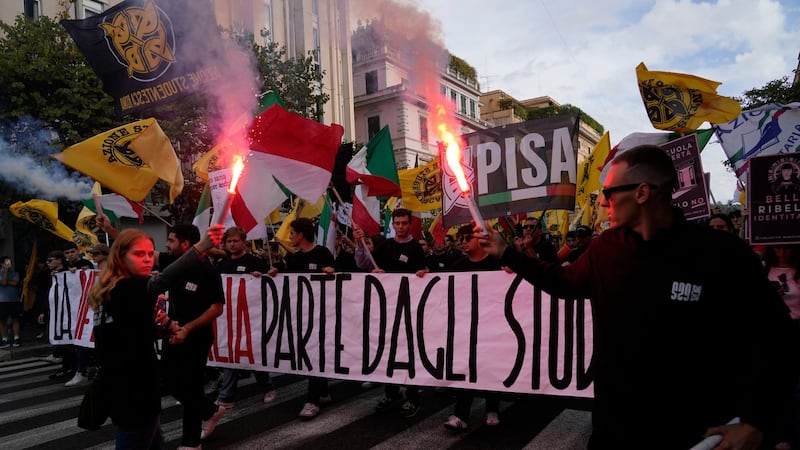
Within the last 24 hours, more than 50,000 migrants have entered Spain’s Ceuta enclave on the North African coast from Morocco, according to the autonomous city’s president. Most of the people who had crossed the border by land and sea are heading back voluntarily, the Spanish government has said. Meanwhile, dozens were reported dead. A Spanish representative in the enclave said 57 bodies were recovered on the Spanish side, and that there could be more in Morocco. Some drowned and some were crushed while trying to climb the border fence, the representative said. Spain deployed its military in an attempt “to maintain security in the city of Ceuta,” the government said. The country’s Interior Ministry said around 50,000 people had crossed the border since Thursday morning and estimated that 48,300 had returned by 6 p.m. (12 p.m. ET) Hundreds rally in Madrid against migrant ‘invasion’ Hundreds of anti-migrant protesters rallied outside Morocco’s embassy in Madrid on Friday evening to denounce what they called a migrant “invasion” of Spain’s north African enclave of Ceuta. Several protesters performed Nazi salutes, some openly and without covering their faces. Many protesters were wearing entirely black, and were chanting “Spain, Christian and not Muslim!” and “national unity!” an AFP journalist at the site said. Some demonstrators carried a large banner reading “remigration” – a term promoted by several far-right groups in Europe that refers to the forced or encouraged return of migrants or people of immigrant background. Others waved Spain’s red-and-yellow flags and called for the defence of “Spanish identity.” AFP 57 bodies recovered on Spanish side The Spanish government’s representative in the enclave of Ceuta said 57 bodies had been recovered on the Spanish side of the border and that there could be additional casualties on the Moroccan side. It said some drowned and some were crushed while trying to climb the breakwater that holds the border fence. Moroccan forces beat back crowds with batons and tear gas at the gates to Ceuta, trying to prevent more from storming across into the tiny Spanish territory that juts on a spit of sandy land into the Mediterranean from Morocco. Reuters More than 48,000 migrants have returned to Morocco: ministry More than 48,000 migrants have now returned to Morocco from Spain’s Ceuta after tens of thousands crossed the frontier into its north African enclave, Spain’s interior ministry said Friday. As of 6:00 pm (1600 GMT) 48,300 migrants had gone back across the border, the ministry said in a message sent to AFP. AFP ‘Encouraged human trafficking’: Italian foreign minister Right-wing parties around the continent blamed the incident on Spain’s comparatively lax migration policies, including an amnesty granted to hundreds of thousands of unauthorized migrants this year. Spain summoned the Italian ambassador to protest earlier comments by Italian Foreign Minister Antonio Tajani, who claimed Spain’s amnesty policy had “encouraged human trafficking.” U.S. President Donald Trump, a long-time critic of Spain’s Socialist-led government, told a cabinet meeting the Ceuta crossings “look like an invasion,” adding: “That same thing’s going to happen to us if the Republicans don’t get elected, except worse,” referring to upcoming midterm elections. The U.S. State Department on X pointed the blame squarely at the Spanish government, saying the incident was a direct result of its migration policies. “We are considering actions to defend Americans at home and abroad from this threat and stand ready to assist other European allies considering similar option,” it said. “This unacceptable incident is the direct result of the Spanish Government’s deliberate efforts to enable and facilitate mass illegal migration into Europe. Meanwhile, French Interior Minister Laurent Nunez said police presence on the Spanish border would be quintupled by Saturday, while reinforcing aerial surveillance and patrols on trains. Reuters Diplomatic tensions? Morocco does not recognize Spanish sovereignty over Ceuta and the other Spanish enclave, Melilla, characterizing the territories - both in Spanish hands for several centuries - as “occupied.” Relations between Madrid and Rabat have improved in recent years after Spain backed Morocco’s autonomy plan for Western Sahara, a territory claimed by Morocco but also sought as an independent state by the Algeria-backed Polisario Front. However, Prime Minister Pedro Sanchez’s visit to Algeria earlier this month was “not viewed positively in Rabat,” said Haizam Amirah-Fernandez, director of the Centre for Contemporary Arab Studies in Madrid. Spain’s Congress also recently approved a bill granting Spanish nationality to the descendants of Sahrawis, a move which experts say likely angered Morocco. “One way of handling that is to send a not very subtle message,” Amirah-Fernandez said. Morocco’s government has not responded to multiple requests for comment on the crossings. Reuters Spanish PM tells EU leaders ‘this is not the time to divide’ Spanish Prime Minister Pedro Sanchez, under fire from some of his peers in the EU over an influx of migrants into Ceuta, said Friday “this is not the time to divide.” “It is the time to continue building a strong and united EU,” he added in a post on X that included statistics on the number of irregular entries into other parts of Europe. AFP Italy ‘will not stand by’: Meloni criticizes Spain Italian Prime Minister Giorgia Meloni on Thursday said Spain should be suspended from the Schengen Area – the EU’s visa-free travel zone – as she called the images from Ceuta as “shocking” in an Italian-language post on X. “I have spoken with Interior Minister Matteo Piantedosi. Italy will not stand by and watch,” Meloni wrote. Spain blasted Italy’s “demagoguery” and summoned the country’s ambassador to Madrid to lodge a protest. But on Friday, Finland backed Italy’s call, while Denmark said the EU should consider such a move. “It goes without saying that the EU must immediately take all necessary measures and consider all options, including a suspension of Schengen co-operation,” Danish Prime Minister Mette Frederiksen said. “Countries that do not fulfil their obligation to protect the external border cannot be members of Schengen,” Finnish Interior Minister Mari Rantanen said. But such a move is not legally possible, according to European texts. “There is no provision in the Schengen framework for this kind of action. One state cannot unilaterally expel another from the area,” Marie-Laure Basilien-Gainche, a law professor at Lyon 3 University, told AFP. AFP Successive crises Ceuta, a territory of 18.5 square kilometres and the nearby enclave of Melilla are Europe’s only two land borders with Africa. During a similar surge in 2021, more than 10,000 migrants reached Ceuta from neighbouring Morocco over the course of two days during a diplomatic spat between the two countries. The row erupted after Spain decided to host for medical treatment a leader of the Polisario Front, whose guerillas fought a long war with Rabat over the independence of the Western Sahara region. The crisis ended in 2022 when Madrid reversed its long-standing policy of neutrality and backed Morocco’s plan for Western Sahara -- a move that had caused a diplomatic rift between Madrid and Algiers. AFP Swimming a feasible option for migrants: refugee charity director When reports spread on social media about a Spanish Supreme Court ruling earlier in July that migrants intercepted at sea while trying to reach Ceuta or Melilla could not be immediately turned back, many saw an opportunity. And calm seas at this time of year make swimming a more feasible option for migrants, said Mauricio Valiente, director of Spanish refugee charity CEAR. Reuters ‘Don’t even know why I came’ Reuters reporters at the enclave border said they saw Moroccan police in riot gear using tear gas to disperse some of the people amassed near the fences. Water cannon trucks were deployed and the charred remains of a bus and seven cars could be seen from clashes with the crowds. On the other side, Spanish military vehicles lined up along sections of the border as dozens of migrants watched from a hilltop in Morocco, unable to cross. Several hundred people could be seen returning to Morocco through border posts and holes in the fence, with some saying they could not find food or shelter in Ceuta. “Honestly, I don’t even know why I came, and now I’m going back,” a young Moroccan man, who said he was from Tangier, told Reuters. “I haven’t eaten since lunch yesterday, even though I brought some money with me ... What we’re doing is neither good nor enjoyable.” Reuters Sleeping in parks, on sidewalks Rachid Sbihi, who leads a local workers’ association representing Civil Guard officers, described the situation as a “serious humanitarian crisis,” saying thousands of migrants, including unaccompanied children, were left sleeping in parks and on sidewalks, while others roamed the streets aimlessly. “It’s chaotic.” The Associated Press ‘People are still coming’ Some of the 41 people who died had drowned, Sbihi said, but some were also killed in a stampede to cross the breakwater fence at Tarajal, an urban beach near a border checkpoint with Morocco. The waters near the border fence were littered with buoys, shoes and other belongings left behind. Ahmed Karim, a 33-year old Moroccan, said he had crossed into Ceuta because of the lack of jobs in his country. “Many people want to go to Europe, America, but they don’t have the opportunity,” Karim said. Moroccan police deployed additional personnel, used water cannons and fired warning shots into the air to prevent migrants from crossing into Ceuta, according to rights groups in Morocco. “Despite the heavy police presence, people crossed through the waterway, while the land border remained closed,” said Achraf Maimouni, a human-rights activist in Fnideq, the Moroccan city bordering Ceuta. Migrants arrested at the border were taken farther into Morocco, away from Ceuta, “but people are still coming,” he said. The Associated Press Why is this happening? According to experts consulted by AFP, there are several possible explanations. One would be the ruling by Spain’s Supreme Court on July 8, which determined that the immediate return of a migrant without opening an administrative expulsion procedure does not apply in the case of sea arrivals. “Without a doubt, the July 8 ruling ... has played a role. But that doesn’t explain the level of mobilization, which is very high,” according to Ignacio Cembrero, a journalist specialized in migration in North Africa. The mass arrival could have been encouraged by the Spanish government’s recent move to regularize people who arrived in the country illegally, or that Spain’s government could change to be replaced by one with a firmer line on immigration. But both of these hypotheses are difficult to confirm, analysts say. AFP Tens of thousands returned to Morocco, says Madrid More than 37,500 migrants have returned to Morocco from Spain’s Ceuta enclave after a recent surge of people crossing the border, Spain’s interior ministry said on Friday. “Departures from Ceuta to Morocco on July 31, up to 3:30 pm (1330 GMT): over 37,500,” the Interior Ministry wrote in a message sent to AFP. AFP France ready to support Spain France stands ready to help Spain tackle a sudden influx of migrants into its Ceuta territory in northern Morocco, and President Emmanuel Macron has given an order to “strengthen controls at the border with Spain,” a presidential aide said Friday. Macron said that “France stands ready to provide the Spanish authorities with any support they may need, should they request it,” the aide said, also referring to support through European border agency Frontex. Thousands of migrants crossed overnight from Morocco into Spain’s north Africa’s Ceuta enclave, sparking a crisis for the Spanish authorities. Earlier Friday, French Interior Minister Laurent Nunez said that he had “given instructions to immediately step up controls at the Spanish border” on Thursday night. AFP