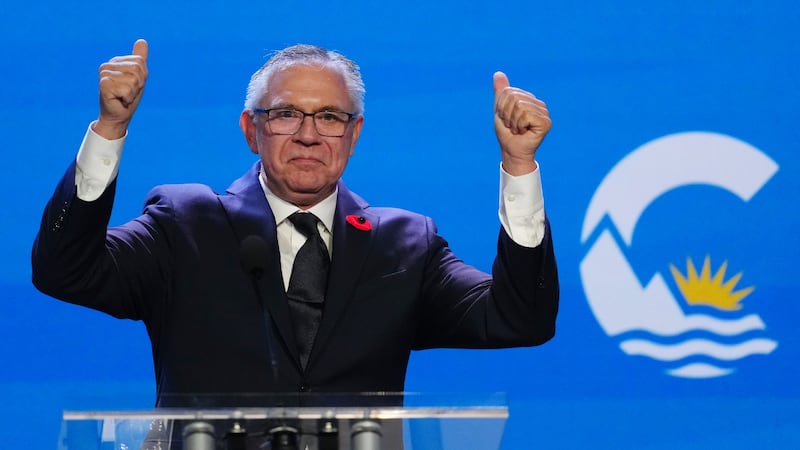
WINNIPEG — Manitoba’s premier says studies showing that year-round shipping is possible from the Port of Churchill boost the case for expanding the Arctic deepsea port. “Churchill could be a year-round port right now, with current technology and using icebreakers and ships that are a lot cheaper, a lot more affordable than we previously thought,” said Kinew at a press conference Friday. The reports say advances in marine technology and declining sea ice due to climate change mean shipping can be greatly expanded from the current four-month window. They show the waterways could be navigated year-round by icebreakers costing between $100 million and $410 million, rather than the billions of dollars it would cost for more heavy-duty ships. Properly designed bulk carriers costing between $60 and $70 million could also navigate the route for nine to 10 months a year under most conditions, one of the studies says. “What that means is a longer shipping season, more economic opportunity. It means that doing (liquefied natural gas) off the Hudson Bay coast is much more realistic,” said Kinew. Shipping with lighter-duty vessels is made more possible as the amount of sea ice shrinks. The window of ice-free water has grown by about a month since the 1980s. Every half-degree of warming adds about two weeks more, another study found. The studies were conducted by the University of Manitoba, Fednav Ltd. and the Arctic Research Foundation, while funding came from the Manitoba and federal governments, as well as the Indigenous-owned Artic Gateway Group that owns the port. Kinew has championed a port expansion, including potential fossil fuel exports, as a key economic driver for the province. But the cost of making it an export terminal for liquefied natural gas could be in the range of $70 billion to $80 billion, he said. “In order for Churchill to move energy products and to be economically viable, we basically have to build a project of that scale.” The port has seen limited shipping activity in recent years, but Arctic Gateway Group has been working to bring back shippers since buying it from an American firm in 2018. “We have invested into the Hudson Bay rail line. We have strengthened the port. We have improved reliability, introduced modern safety technologies and work towards bringing customers and cargo back,” said Michael Spence, mayor of Churchill and chair of Arctic Gateway. He said the first grain shipment is set to sail out next week and the first potash shipment soon after. While limited shipments have restarted, business groups are still wary of committing to the port that requires significant upgrades and has shipping limitations. The federal government launched a study in February to gauge business interest in the port. It said the study should be done by the end of March but not what it might include. Kinew declined to reveal those findings, saying it’s not his report to release. The port is among the projects referred to the federal major projects office as a transformative strategy. It was not among the first round approved for fast-tracking. This report by The Canadian Press was first published Aug. 21, 2026. Ian Bickis, The Canadian Press