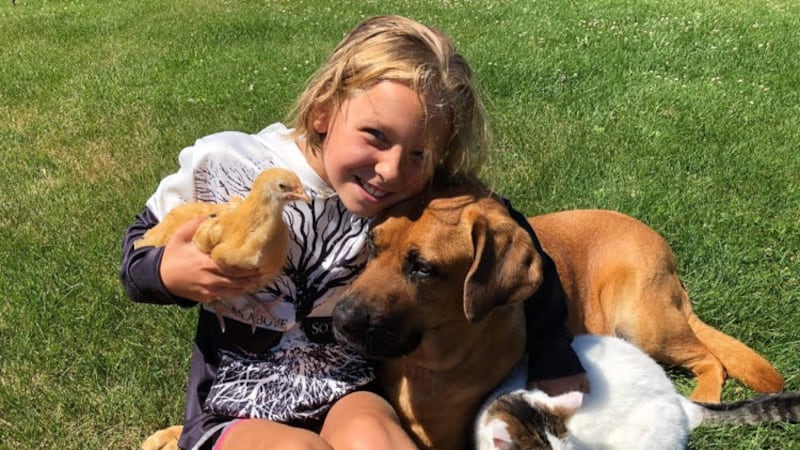
Seven months after 15-year-old Chase De Balinhard was shot and killed by RCMP in Surrey, B.C., his family and community are still waiting for answers. The teen, who was on the autism spectrum, died after an armed police response to a 911 call about a person in distress with a firearm. His parents say he was carrying an unloaded pellet gun. While the Independent Investigations Office (IIO) of B.C. continues its probe — now stretching four times longer than the agency’s average case length — questions remain about whether lethal force was the only option officers had that day. ‘There was no de-escalation’ Chase’s mother, Crystal De Balinhard, has watched surveillance video of her son’s final moments over and over. “All I know is that, from what I saw on the video surveillance that I was given … he was non-aggressively walking away from the RCMP,” she said. “There was no de-escalation. They were yelling multiple commands at a time.” Crystal says her son didn’t die instantly. “We could hear him on the ground, and he was moaning.” For her, the lack of communication and calm intervention raises the most painful question: could Chase have survived if officers had responded differently? Critics say officers had protection—and time Former solicitor general and West Vancouver police chief Kash Heed has reviewed the surveillance video several times. He believes the RCMP officers’ positioning behind their vehicles offered them protection — and potentially more options. “Given the fact that there was no other further de-escalation technique, it kind of concerns me, because I’m not sure the officers were in immediate danger that they had to utilize that level of force,” Heed said. In his view, the RCMP SUV officers used for cover could have bought them the opportunity to slow the situation down and consider alternatives. “We’ve seen the use of Arwen guns, which is a rubberized 37 mm bullet. We’ve seen bean bag shotguns that have been utilized with people that have weapons,” Heed added. The video shows Chase walking with a pellet gun to his head, turning briefly toward officers before raising the weapon. Heed argues that, in that moment, police could have slowed things down. “Someone that’s holding what appears to be a firearm to their head obviously indicates to you that they are in some type of distress,” he said. “You want to talk them down from that. You just don’t want to yell commands at them.” He emphasized that while officer safety must come first, modern policing requires equipping members with alternatives to firearms. The case for context But experts caution against drawing conclusions from a short clip. RCMP say the video released publicly represents less than a minute of what was, in reality, an approximately 40-minute-long interaction. Bruce Pitt-Payne, a retired RCMP major crimes investigator, says the full sequence of events needs to be examined — starting long before officers even arrived. “They’re going to want to know the training. They’re going to want to know what experience the person had,” Pitt-Payne explained. “Research has shown that the words from a dispatcher could prime or set the stage for what the officer believes they’re walking into.” The RCMP’s initial news release on the incident said a call came in around 2:39 p.m. that “an individual was in distress and reportedly armed with a firearm in a school yard,” in the 7000 block of 188th Street, the area of Clayton Heights Secondary. As it was a Sunday, school was not in session. The IIO’s investigation will examine whether officers acted lawfully and reasonably in the circumstances. But with seven months gone and no findings released, families and witnesses are left in limbo. Pitt-Payne says the delay isn’t unusual. In fact, he argues it’s often necessary. “Good investigative work takes time, and to do the good work, you have to leave no stones unturned,” he told CTV News. “It is a serious case, and they’re going to be treating it as such.” A complex investigation Pitt-Payne says police watchdogs like the Independent Investigations Office of B.C. must establish not only what happened, but why it happened. That means piecing together the officer’s state of mind: What they knew at the time, how they interpreted the information, and why they responded the way they did. “It’s very complex,” he explained. The process involves scrutinizing video and physical evidence, interviewing officers and witnesses, and reviewing police training and policies. Each step takes weeks, sometimes months, to complete. Public trust and officer stress While the investigation plays out, Pitt-Payne says both public perception and officer well-being hang in the balance. “The public needs to know it’s impartial,” he said. “Perception is important. And for officers, to be cleared by an independent agency means so much more. Nobody wants people to think it was some sort of cover-up.” For the officers involved, the wait can be excruciating. Some are placed on leave, while others work in modified roles depending on their mental health. “It’s probably the most stressful part of police work,” he said. “You feel all alone. Even if you did nothing wrong, the weight of an investigation is enormous.” The B.C. RCMP sent an initial news release on the incident, but has declined to comment on the case since while the IIO Investigation is underway. The challenge of de-escalation Witnesses have questioned whether RCMP officers could have de-escalated the confrontation with Chase. Pitt-Payne is cautious about second-guessing in hindsight. “De-escalation isn’t a magic wand,” he said. “It’s an offer — you’re asking someone to choose to bring the situation down. Officers may have seconds to decide what we have months to analyze.” While he acknowledged police training around neurodivergence could be strengthened, he noted that no two situations — or individuals — are alike. Even once the IIO releases its findings, Pitt-Payne believes further review could help prevent future tragedies. “I think we should always welcome a coroner’s inquest,” he said. “It’s not about punishment, it’s about learning. Sometimes that can bring out more information.” For him, what matters most now is supporting all those affected. “This is a tragedy all the way around,” he said. “The family of the young man, the police officers, the witnesses — there’s a lot of pain that has come out of this. We can only hope now for healing.” Training, autism, and split-second decisions Witnesses Jordan Brown and Shavaun Pellatt, who watched the events unfold, remain shaken. “Why was he shot, and shot to kill?” Brown asked. “This was a kid.” For Chase’s family, the wait for answers only deepens their grief. With the IIO report still pending, they are left to piece together fragments of evidence, expert opinion, and their own haunting memories. Al Arsenault, a use-of-force expert and longtime police trainer at B.C.’s Justice Institute, says officers receive crisis intervention and de-escalation training every three years. But recognizing and adapting to neurodivergent behaviours in high-stress encounters can be difficult. “If the officers were maybe, possibly better trained, maybe they recognized this kid’s on the spectrum, and maybe the outcome would have been different,” Arsenault said. “I don’t know. You’d have to ask the officers, what were you feeling? Subjectively, was your life threatened?” He notes that police are trained to “shoot to stop the threat,” typically aiming for the torso as the largest, least mobile target. But he also acknowledges that non-lethal strategies — such as bean bag rounds — can be effective if backed by lethal cover in case they fail. “That’s worth a try,” he said. “It saves a lot of lives doing that.” Arsenault spoke from his own experience, and not on behalf of the Justice Institute. CTV News asked to speak to JIBC on use of force training in general, not Chase’s case specifically, but a spokesperson declined. While municipal police are trained at JIBC, the spokesperson noted RCMP officers are trained separately by the national police force. The reality of split-second choices When it comes to lethal threats, Arsenault stresses that context is everything. “Distance is your friend,” he explained. “Distance buys time — time to think, time to call in backup, time to use cover.” Asked what he would do if confronted with someone appearing to draw a firearm, Arsenault is blunt: “I’m not going to wrestle with the guy. If he’s got a gun, my gun is out, and I’m giving clear commands: Don’t reach for that weapon, you will be shot.” Less-lethal options like Tasers or beanbag rounds may be considered if there’s distance, cover, and lethal backup in place — but he’s clear they aren’t realistic substitutes when lives are immediately at risk. “You’d never bring a Taser to a gunfight,” he said. “That’s just monumentally stupid.” Autism training: Limited but ahead of the curve Arsenault admits that when it comes to responding to incidents involving people on the autism spectrum, police training still has gaps. He says at the Justice Institute, recruits get a day of communications instruction and an online module about autism, but he says it’s “rather limited” compared with the complex situations officers encounter. “If a person is non-verbal, you don’t know what’s going on,” he said. “Are they mentally ill? Are they just done with life and want to shoot you? You don’t know the difference.” Globally, he’s found wide differences in training. In Taiwan, recruits spend up to four years in school, with more time for communications and defensive tactics. In places like Melbourne, where classes are huge, officers get just days of refresher training each year. “They call it pump and dump,” he said. “There’s no integration, no time to reflect on how all the training fits together.” Still, he believes B.C. is “ahead of the curve” in North America, particularly with its three-block academy system that mixes classroom and field experience. A broader social problem Arsenault rejects the idea that B.C.’s challenges are unique. “Everywhere I’ve gone — Alaska, Idaho, Australia, New Zealand — there’s always a skid row,” he said. “Homelessness, drug abuse, mental illness, it’s everywhere.” But he is blunt that police are being asked to do too much. “We’re the de facto wardens or psychologists,” he said. “All of society’s failings fall upon the police’s shoulders. Something goes wrong, someone gets hurt, and suddenly it’s the police officer’s fault.” Instead, he argues, mental health services should intervene long before someone spirals onto the street. “Why wait until the bomb blows up and police have to mop up the blood and guts?” he asked. The push for specialized responses Some advocates argue officers should be paired with mental health or disability specialists. Arsenault disagrees. “I shouldn’t have police officers doing this job,” he said. “It should be dealt with by the proper people who have degrees and knowledge in helping.” He points to cases, like Chase’s, where better training might have changed the outcome — but stresses the underlying issue is that police are asked to be doctors, lawyers, psychologists, and social workers all at once. “You can’t expect police officers to do it all,” he said. Coroner’s inquests: a double-edged sword Arsenault supports coroner’s inquests when deaths occur during police interactions, calling them a way to “move training in a more productive, safer way.” But he cautions that juries sometimes recommend blanket bans that remove valuable tools without considering the consequences. For him, the core issue is balance: society needs police who are well trained, but also needs to stop treating officers as the solution to every social failure. “Policing evolves with society’s problems,” he said. “But if we keep piling everything onto officers, we set them up — and the public — for failure.” A system under scrutiny Chase’s death has reignited debate about how police in B.C. respond to people with mental health challenges and developmental disabilities. Families and advocates are calling for more autism-specific training, while experts continue to debate whether the officers that day had other viable options. For now, the central question remains: was lethal force the only option? Until the IIO releases its findings, Chase’s parents are left without closure — and the public without a clear picture of whether this tragedy was preventable. CTV News will continue its investigative series on Chase De Balinhard’s death throughout this week. Wednesday’s story focuses on the autism-specific training police officers receive in B.C. Follow all the coverage here.