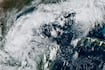
A severe, spectacular storm hit B.C.’s South Coast Saturday night—causing disruptions at Vancouver’s airport and sparking new wildfires. At the airport, people on dozens of flights were stuck on the tarmac until early Sunday morning. The intense weather grounded all departing flights between 9:30 p.m. Saturday and 2:55 a.m. Sunday, according to a statement from YVR. “Many arriving flights were unable to taxi to the gate once landed. This resulted in flight delays and some cancellations,” the statement said. A spokesperson for YVR said the airport was under a “red alert” which meant “nobody (was) working airside as it’s unsafe with the threat of lightning.” Because ground crews were unable to get planes to the gates, a total of 39 aircraft were waiting when the alert was lifted at 2:55 a.m. The storm also caused flooding inside the terminal, which did not impact operations. Anyone with a flight Sunday was urged to check its status amid ongoing delays and cancellations. “Although the weather has improved, some flights continue to be impacted,” a statement from the airport said. No storm-related weather warnings were in effect for the region Sunday morning, but Environment and Climate Change Canada did post an update online. “An upper-level trough crossed southern B.C. overnight. The trough brought unstable atmospheric conditions to the region, triggering numerous thunderstorms across southern B.C,” the agency said. “These thunderstorms produced localized heavy downpours, resulting in heavy rain in some areas.” At the airport, the worst of the deluge came between 10 and 11 p.m. Saturday, during which 22.2 millimetres of precipitation were recorded, according to the weather agency. Environment and Climate Change Meteorologist Gary Lee told CTV News that on average, the weather station at Vancouver International Airport sees 4.4. days of thunderstorms per year. Records there date back to 1911. “It’s pretty rare,” he said. Lee said there were 1,813 lightning strikes recorded across the Lower Mainland. Because the storm peaked at night, both the sound of the thunder and brightness of the lightning would have seemed more intense, Lee added. The B.C. Wildfire Service said there were more than 7,000 lightning strikes recorded Saturday—sparking new blazes across the southern part of the province. The B.C. Wildfire Service said there were more than 7,000 lightning strikes recorded Saturday—sparking new blazes across the southern part of the province. “Fortunately, many of the areas affected by lightning also received good precipitation, helping to decrease fire behaviour and the likelihood of new starts,” an online update Sunday said. According to the BCWS, more than 70 new fires started in a 24 hour-period. Social media was flooded with images and video of the storm.