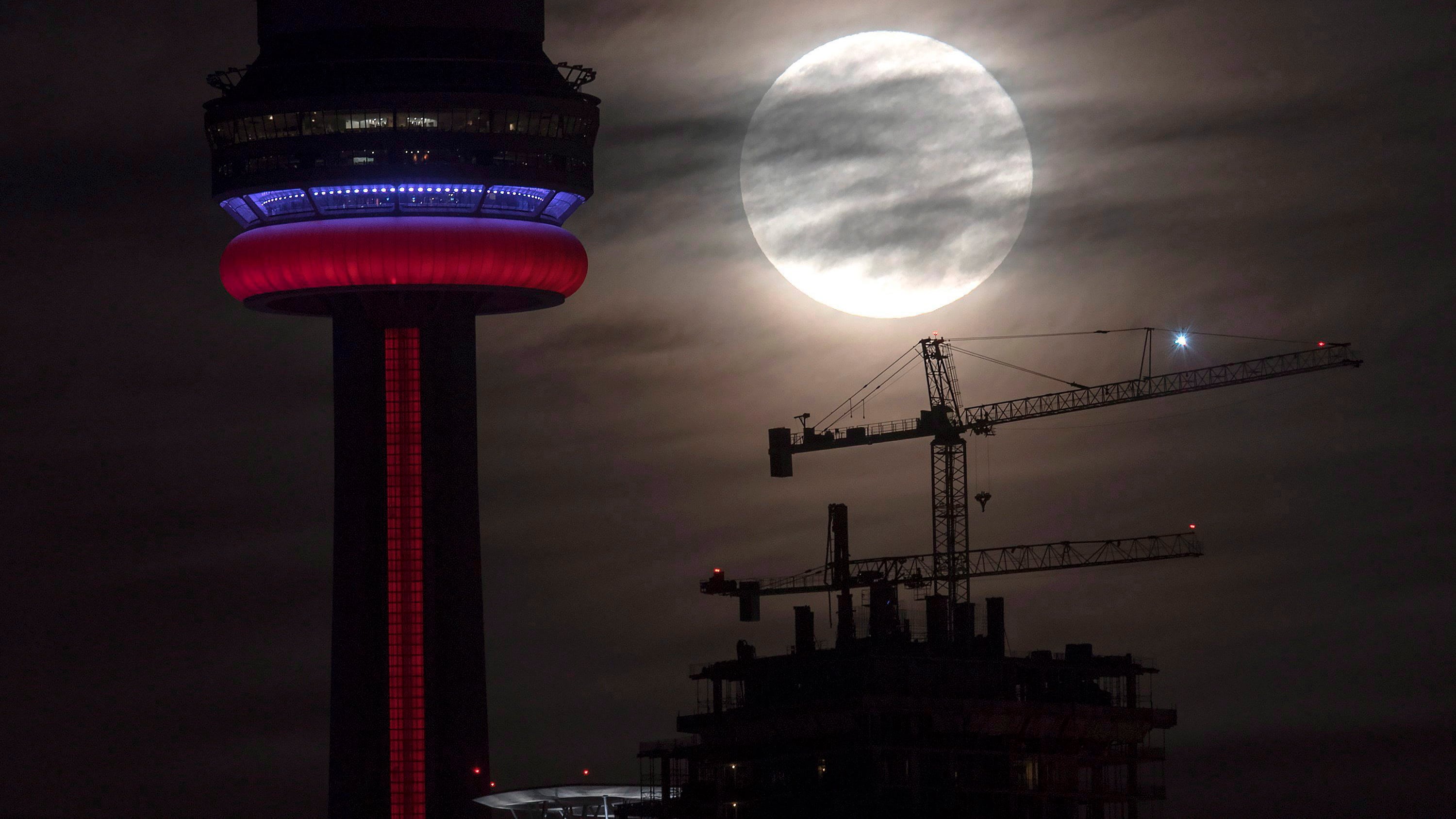
Look up tonight to see the largest and brightest full moon so far this year. Known as the harvest moon, tonight’s full moon is also the first supermoon of 2025. Because the moon doesn’t orbit the Earth in a perfect circle, sometimes its elliptical path brings it slightly closer to our planet, making it appear larger and brighter. While not an official astronomical term, a “supermoon” refers to a full moon that occurs when the moon is near its closest point to Earth. That closest point is called the perigee and is about 363,300 km from Earth, according to NASA, while the furthest point, known as apogee, is about 405,500 km away. According to NASA, a full moon during perigee can appear up to 14 per cent bigger and 30 per cent brighter than the furthest and faintest moon of the year. While perigee and apogee occur during every 27-day lunar orbit, perigee does not always coincide with a full moon. According to NASA, tonight’s supermoon will reach its peak at 11:48 p.m. ET. Supermoons occur three to four time a year and they always appear consecutively. The next two supermoons will take place on Nov. 5 and Dec. 4. A “harvest moon,” meanwhile, refers to the full moon that occurs closest to the autumn equinox, which was on Sept. 22. Before electricity, farmers relied on moonlight to gather crops during the important autumn harvest at the end of the growing season. Marking the start of autumn in the Northern Hemisphere, the equinox occurs when the sun is directly above the Earth’s equator, resulting in almost equal amounts of day and night. The harvest moon also coincides with the annual Draconid meteor shower, which will be active between Oct. 6 and 10. Bright moonlight, however, will make it harder to see the meteor shower, which peaks on Oct. 8.