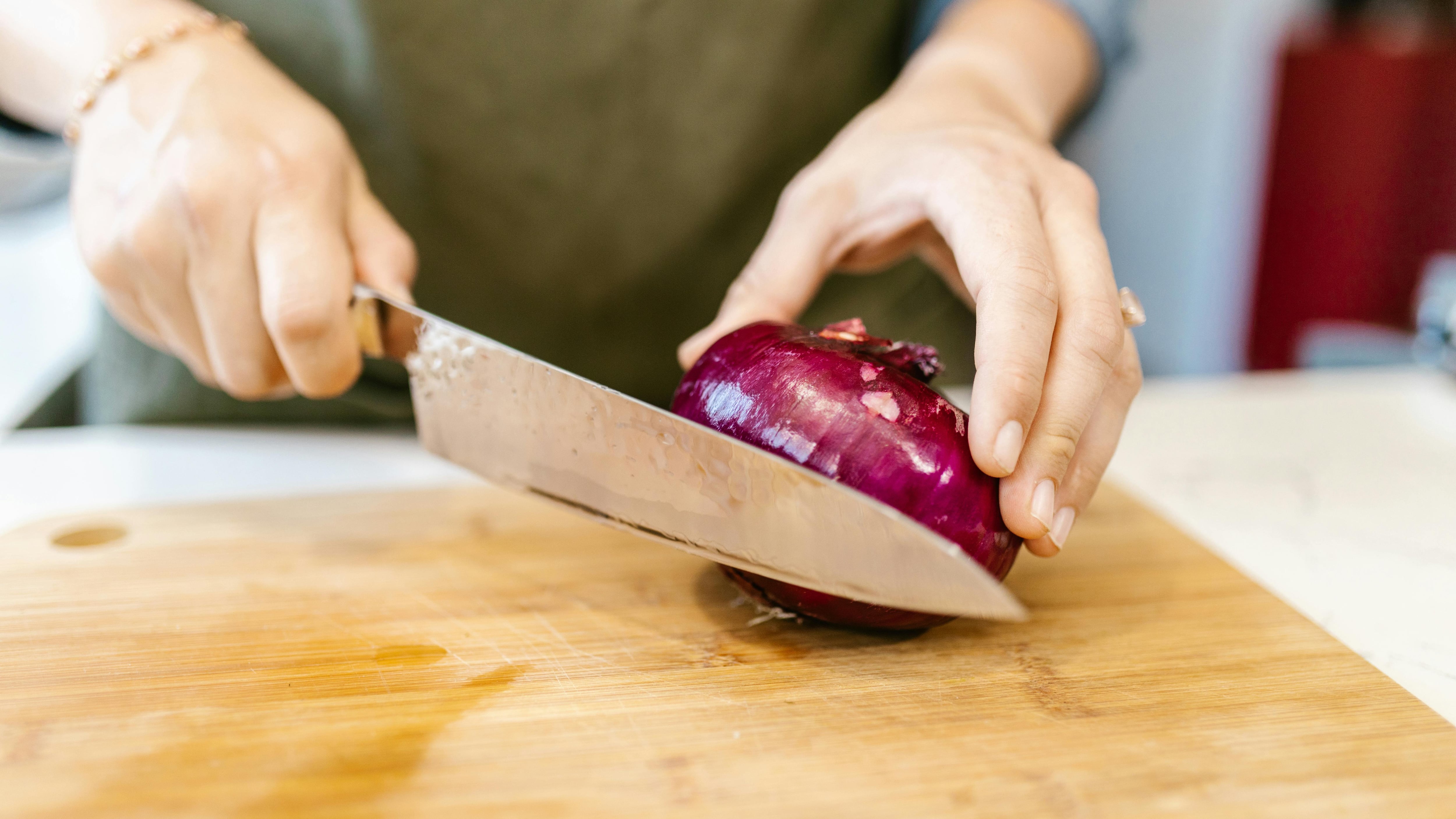
As any cook knows — professional or otherwise — chopping onions is a teary affair. There are several tricks that claim to help prevent watery eyes when slicing the pungent vegetable. Chewing gum, freezing the onion and wiping the blade with a lemon are some tips that are believed to help alleviate runny eyes. But one recently published study in Proceedings of the National Academy of Sciences examined the most optimal way of preventing tears when chopping onions, and according to them, all you need is a sharp knife and slow chopping skills. Navid Hooshanginejad, one of the study’s researchers, explained that his postdoc work at Cornell University was initially meant to examine droplets spreading pathogens, as the study started during the COVID-19 pandemic. But as he and other researchers discussed it more, they realized that the vapour produced while cutting onions resembled the physical principles of droplets spreading pathogens. “We came up with the idea that ... even when you’re chopping onions, you’re having the same concept that droplets are atomizing and spreading out,” he told CTVNews.ca. “Why don’t we just study this problem?” The researchers set up high speed cameras, cut close to a thousand onions and recorded the process over several months. They used various levels of blade thickness, both sharp and blunt, set up different levels of height, as well as the speed of cutting to help understand the universal guideline for cutting onions, so the cutter doesn’t end up crying. Once a clear shot of the vegetable was captured, Hooshanginejad and his colleagues were “fascinated and surprised” by how large and fast moving the droplets were. “We came up to these conclusions that when you’re chopping the onion, faster, essentially ... you have a really high kinetic energy of your blade that’s coming to a stop in the end of the process,” Hooshanginejad said. “All that kinetic energy has to be transformed to kinetic energy of the droplets that are being atomized.” In simpler terms? “So essentially the faster you cut, the faster these droplets will fly,” he explained. The same principle applies when you’re using sharper versus blunter blades - the blunter the blades are, the larger the area underneath in the onion that’s being pressurized. “It’s a really large surface that’s just being pressurized,” he said. “By the time it ruptures, there’s going to be a really large volume and reservoir of onion juice underneath that.” When the onion is chopped up with a blunter blade, the pressure and high volume of liquid is going to burst out and atomize to much smaller droplets, which will spread much higher, because the droplets now have a much higher kinetic energy and speed. Researchers also found that a few factors, like the size of the onion, how many layers are already peeled back, or which direction the onion is being chopped - either top to bottom or across - also impacted how the droplets spread. However, Hooshanginejad said those aspects are being studied further. “The data wasn’t as conclusive as it was for sharpness and speed, which we concluded in the paper,” he said.