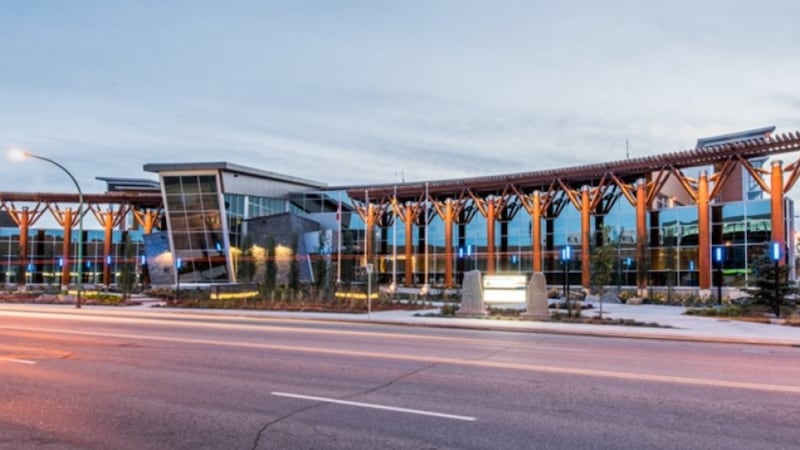
Ladies’ night looked a little different Tuesday for the hundreds of women attending Chippendale’s stop in Saskatoon. As groups of women poured into TCU Place to watch the acclaimed striptease touring dance troupe, tucked away at the back of the lobby were some volunteers and puppies from New Hope Dog Rescue. This wasn’t just some clever partnership — it was an obligation under a decades-old rule in Saskatchewan. “Once you have a show that has that act of stripping going on, the regulations basically say that if you’re going to do that, you really can’t open a bar of any kind,” said Kirby Wirchenko, the director of theatre and programming at TCU Place. “And because of the license we have, we have the ability once a year to do an exception to that.” The Saskatchewan Liquor and Gaming Authority’s (SLGA) alcohol control rules have strict regulations surrounding nudity or stripping of any kind. In short, alcohol and nudity cannot be mixed in Saskatchewan. But certain permit holders are allowed to open a bar for a striptease performance once per year — only if it is “part of a fundraising event to support a charitable or community purpose.” On Tuesday, TCU Place redeemed its yearly right to sell alcohol to a flesh-ogling crowd. “And so as soon as I thought about having some oiled up male dancers and some fuzzy dogs on the same site, I thought, how could we ask for a better Tuesday?” Wirchenko said. While the rule may seem prohibitive or restrictive to some, Wirchenko says it’s all part of doing business in the entertainment industry. The strange circumstance isn’t lost on him, especially considering the hypocritic nature of alcohol being sold at movie theatres, sporting events like minor hockey or many other places where minors are present — but not if men take their shirts off. “I don’t understand what is dangerous or unpalatable about that,” he said. “Do you think that people will suddenly be more prone to commit crimes? I mean, people can drink in a million venues in Saskatchewan, and they can do it from 10 or 11 in the morning till 2 a.m. We’re talking about a 100-minute window where people have paid money to come see a show, and they want to have a glass of wine.” Many ladies at the show were unaware liquor can’t typically be sold at a strip show, but they were happy to visit with the pups and say it’s all for a good cause for a charity operating on a tight budget. “I just thought it was ok,” Melissa Watts said before Chippendales performed. “Given everything that’s on the internet.” Of the liquor laws, Giselle Sakowsky told CTV News “it seems a little selective.” “I was kind of surprised to actually see the set up there with New Hope. It’s surprising because it’s two different spectrums, but I guess you need to take advantage while you can, because there’s a lot of dogs that need to be adopted.” Saskatoon’s conflicted relationship with alcohol Saskatoon’s history with liquor licensing is well-documented and traces its roots back to the formation of the city. Saskatoon was founded in 1883 by the Temperance Colonization Society, intended to be a utopia free of alcohol and other vices seen in large cities in eastern Canada. Saskatoon first liquor permit was issued in 1899 to the Windsor Hotel on First Avenue. The Temperance Colonization Society wasn’t functioning, but those in power still held many of their beliefs and quickly shut the bar down. However, by 1903 the three hotels in downtown Saskatoon all attained liquor permits and effectively ended the temperance movement as a driving force in the city. Until 1915 when prohibition shut down all bars in the city, liquor licenses were tied to hotels only, which required food and beds to accompany any sales. When bars reopened in 1935, it was as beer parlours, only available to men — and it remained that way until 1960. “So, if you were a woman in Saskatoon, Saskatchewan, you couldn’t drink in public until 1960, when there was a major liberalization of the liquor laws,” City archivist Jeff O’Brien said. New liquor permits allowing licensed dining rooms, restaurants and lounges changed nightlife in Saskatoon. Other changes like allowing bars to open on Sundays happened in the ’80s, but no matter the changes, the attempts of mixing alcohol sales and nudity or stripping was always “a hard no,” according to O’Brien. Places like the Flamingo Cabaret on 20th Street featured exotic dancing, however this supposed dry club was eventually shut down, partly due to liquor being sold under the table. Other places with “go-go” dancers were told by liquor inspectors the scant clothing wasn’t enough, and they were closed. Saskatoon’s most famous strip club was Showgirls, which was under constant threat from both City Hall and provincial officials for potential infractions throughout the ’90s. Club owner Cory Thompson, who was forced to shut the bar down for infractions, challenged provincial law, eventually receiving an injunction allowing the bar to remain open while its case moved through the courts. The Supreme Court declined to hear the matter and upheld the Saskatchewan Court of Appeal decision, closing the bar in 2001. The bar reopened in 2004 when Champs Sports Bar opened in one half of the building. This forced customers to drink on one side and forbid alcohol where the stripping was happening. It was ultimately shut down for good after repeated squabbles with City Hall over bylaw enforcement. The latest liquor law revamp happened in 2014, which included sweeping changes like eliminating the law banning striptease in bars. It was short-lived. “That only lasted a year. In 2015, the government kind of rolled out back to where it is today, which is that you get to have this one performance per year, and it has to be connected to a charity,” O’Brien said. O’Brien says no matter how you feel about TCU’s efforts to open its bar Tuesday night, the liquor laws in Saskatchewan have always reflected the will of its people and the many iterations of community or church-driven activism. “In Saskatchewan, we always got the liquor laws we wanted every single time,” he said. “The government has never really been interested in legislating liquor.” TCU Place was happy to give half of its bar proceeds to New Hope Dog Rescue, which in turn was happy to partner with the theatre under unique circumstances. With its bar lined up for more than half an hour prior to the show starting, many people were unaware of this longstanding provincial law and its impact. “I have a hard time understanding why in 2026 there are still certain things that are holding an event like this to such a narrow spot,” Wirchenko said. “Maybe it’s time to at least relook at it.”