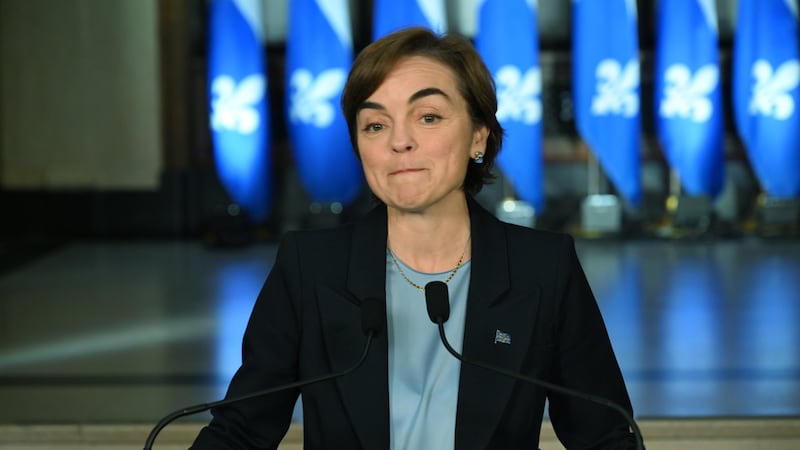
The Government of Saskatchewan will be mailing out a questionnaire to every household, posing the question of limits on social media for young people directly to residents. Premier Scott Moe officially announced the move on Tuesday, beginning his remarks speaking about the province’s approach to drug addictions and treatment before transferring into the discussion around social media. “Like all parents and caregivers, we want our kids to be safe,” Moe said. “Social media, we understand, can have a very positive role to play in so many individuals, and in particular in youth’s life. It can help young people connect, to learn to express themselves, but we also know that there are negative aspects and there are serious risks to that connection to social media platforms as well.” The $500,000 mail-out campaign consists of a four-question survey, asking residents if they would support social media limits for children and what age those limits should be applied to. Additionally, the questionnaire asks if any social media platforms should be exempt. For residents opposed to social media limits for youth, the survey asks if they would support parental consent for kids under 16. “We look forward to hearing the opinions of Saskatchewan families directly. We strongly encourage everyone to take the time to express their views and return the postcards so that your voices can be heard,” Addictions and Mental Health Minister Lori Carr told reporters. Both Moe and Carr stressed the province’s eventual stance on the topic would be wholly shaped by the results of the survey — even if residents were in opposition of a ban — which would buck national trends. “If the people don’t want us to move in this direction, yeah no, we’d take that direction. Certainly,” Moe noted. Sharing their personal opinions, both Moe and Carr said they believe there are benefits from limiting social media use for children. “I grew up without social media, so I don’t see it as a necessity,” Moe said. “I truly see the benefits of limiting the amount of time that my grandchildren spend on social media or on a device, just in general, because the connection that you have with human beings is just irreplaceable and much more healthy for them in developing their life skills,” Carr added. The premier reiterated that his government looked at the prospect of provincial legislation, even exploring legal options, but ultimately decided that a national conversation and a Canada-wide approach was needed on the issue. “We’ll represent Saskatchewan parents within what would be a national ban, which we think would have far higher chance of being effective and impactful than any patchwork of provincial limitations,” he said, referring to Manitoba’s intentions of pursuing a ban at the provincial level. The survey results will need to be returned by June 30, 2026. Moe originally floated the idea of asking residents their opinion on banning children under 16 years of age from social media in late March. The announcement came after a poll by Angus Reid suggested a majority of Canadians would support a ban similar to the one Australia has recently imposed. Additionally, at the Liberal Party of Canada’s convention in April, members passed a non-binding resolution calling on the government to set a minimum age of 16 for those accessing social media. Marketing agencies support ban Strategy Lab, a digital agency in Regina, said a ban would help prevent marketers from targeting children online. “In general, we like to say we don’t ever target anybody under the age of 18. I know what I’ve done on the internet and advertising apps like TikTok, we used to call the wild, wild west because there wasn’t an age gate,” said Jeph Maystruck, chief interrupting officer of Strategy Lab. “I could advertise to 14-year-olds. Should marketers be able to do that? Absolutely not … If this is going to help, if age gates can help stop that from marketers, all the power to them.” Sarah March, owner of Grey Dove Design House, also voiced support for restrictions. Though, she noted that not all apps have the same influence on children. “I think the biggest one like Snapchat and YouTube would be the ones [that] would really affect children,” she told CTV News. “From my understanding, most kids are too cool for Facebook now, but they have like a Facebook Messenger, which is nuts to me.” As a parent herself, March sees the value in restrictions for minors, despite social media being a great tool for adults. “All the platforms are great to connect with like-minded adults, especially in the same age where most parents are busy and running from different jobs and kids activities,” she shared. “But, I don’t think that it’s necessary for children. I have a nine year old and I will keep her off of social media until she’s at least 16. I don’t think that this ban is a bad idea at all.”