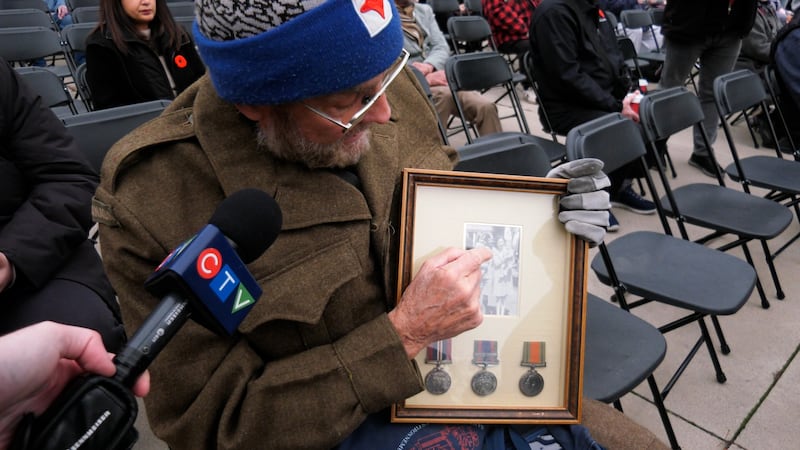
First displayed in the Saskatchewan Legislative building’s rotunda until 1977, the Royal Regina Rifles’ regimental colours have returned to their original home. A ceremony was held on Wednesday by Lieutenant Governor Bernadette McIntyre, Saskatchewan Premier Scott Moe, Provincial Military Liason Blaine McLeod, members of the Royal Regina Rifles and guests to mark the return to the rotunda. “I’m chilled to the bone to know that these flags were on European soil, where Canadian soldiers fought for our freedom,” McLeod said. The colours were originally gifted to several Saskatchewan regiments from the people of the province after World War I, honouring the 28th, 68th, 195th, and 249th battalions of the Canadian Expeditionary Force. In 1977, Rifles’ regimental colours were relocated to St. Paul’s Anglican Cathedral in Regina, the regiment’s church. Regimental colours are an important symbol in military tradition. They display crests, badges, and battle honours earned through service. The Regina Rifles’ colours will now be publicly displayed to serve as a visible reminder of the soldiers who served their country, according to the province. The Royal Regina Rifle regiment says 10,000 Canadians fought under the colours during the battles of World War I, with around 6,000 becoming casualties, and a total of 922 killed in action. “They want them to disintegrate within time, they’re going to be here for a very, very long time, hung where they were originally placed,” said Lieutenant Colonel Kevin Barry. “This is for the people of Saskatchewan to see what those fighting men, who fought for our freedom, these are the most treasured possessions of those men and those regiments.” John Watson is the last surviving World War II veteran of the former Regina Rifle Regiment who was on hand to see the flags return to the rotunda. “It’s a real honour to be here, and to see the colours back, where they [once] were,” he said. Those touring the legislative building will now see and hear about another part of Saskatchewan’s military history as they look up in the rotunda. “They should look within themselves to see what it is that they treasure for their freedom, the things that they are free to enjoy every day,” Barry said. “I don’t think there’s many people that really know the story, and so when they come into this legislature and see these flags, what are they? and what are they for?” Four of the flags that are displayed were carried by Saskatchewan soldiers on the battlefields during World War I.