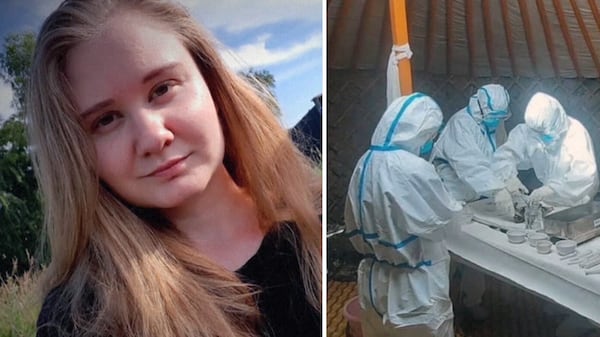
Montreal police (SPVM) say they solved the 17-year-old murder of Catherine Daviau thanks to DNA technology. The 26-year-old woman was killed in a Rosemont triplex on Dec. 11, 2008. With the help of the Laboratoire de sciences judiciaires et de médecine légale (a forensic science and medical lab in Quebec), detectives tied Jacques Bolduc to the crime scene. Bolduc died of natural causes at Archambault federal, where he was serving an indeterminate sentence for two armed robberies and attempted murder, in September 2021. He was arrested in 2017 and sentenced in 2020. In December 2008, police were called to investigate a house fire on 5th Ave. near Masson St., and found her body with marks of violence and sexual assault. Officers suspected the killer tried to hide the murder by setting the apartment on fire. At first, it was believed that Daviau knew her killer and invited them into her home, as there were no signs of forced entry, and the attack happened shortly after she would have gotten home from work. Police found DNA at the scene, though they could not match it to anyone in their database — but technology has evolved significantly since then. At a news conference Wednesday afternoon, Melanie Dupont, head of the SPVM’s major crimes division, said phone records show Bolduc contacted Daviau a few days before her death. She was trying to sell her car and posted an ad online. According to interviews with one of Daviau’s coworkers at the time, she had mentioned that a man planned to come by to check out the car on Dec. 10, but he never showed up. “Was he watching her at this time? We can have that hypothesis,” Dupont said. “We know with certainty today that on Dec. 11, he was there.” Bolduc was out on bail and staying at a halfway house with a strict curfew at the time. He never went back after Dec. 11 and was arrested two days later in Sherbrooke for attempted car theft. His cell phone was confiscated and his number redistributed, so by the time police got Daviau’s phone records it was no longer tied to Bolduc. Nothing else tied Daviau to Bolduc. Despite having a criminal history starting in the late ‘70s, Bolduc was not known as a sexual predator. He was never interrogated in connection with Daviau’s murder as he was not a suspect until DNA technology linked him to the crime scene. Using genetic genealogy Dupont said her team never gave up on trying to find answers for Daviau’s family and followed hundreds of leads. The breakthrough came when the forensic lab flagged a DNA profile resembling that found at Daviau’s crime scene. The lab has access to the national DNA bank as well as recreational DNA sites like 23andMe. Police typically need a judge to order a DNA sample from convicts for the national bank, while people sending their swabs to recreational labs can consent to give the forensic lab access. Once a relative — even a distant relative — sends their DNA to the lab, it can be flagged as a potential match to DNA linked to a criminal case. From there, a genealogist builds up the person’s family tree. Based on age, location and other factors, targeted profiles are then passed on to detectives who can corroborate. In Bolduc’s case, it took eight months to confirm he was the killer after his profile was flagged by the lab. A judge approved sampling his DNA in June 2020, but due to COVID-related delays, Bolduc died before police could take the swab. Once detectives started digging deeper into Bolduc’s past, they found the Because he was cremated, police requested DNA from his close relatives to confirm the match. The future of cold cases Suzanne Marchand, senior director of the Laboratoire de sciences judiciaires et de médecine légale, told journalists at the news conference she wants this case to give hope to the hundreds of families waiting for answers on their loved one’s death. “For all those who feel like nothing is happening in their case or that it was pushed aside, that is not the case. We never give up,” she said. Several cold cases in Quebec have been solved recently based on DNA evidence, including 16-year-old Sharron Prior’s 1975 murder, and a suspect was prosecuted in Guylaine Potvin’s murder nearly 24 years later. Rodney Nichols, a former Montreal resident, was also arrested in March 2024 after his DNA linked him to the 47-year-old murder of Jewell Parchman Langford, known as “the Nation River Lady.” The SPVM and its major crimes section noted that investigating unsolved murders is one of its priorities for 2025. There are over 800 unsolved murders on the force’s territory since 1975. Last March, 16 new detectives were hired to work full-time on unsolved murders. Dupont said DNA testing is an important tool, but not all cold cases can be solved with this technique as police don’t always have access to DNA linking suspects to the crime scene.