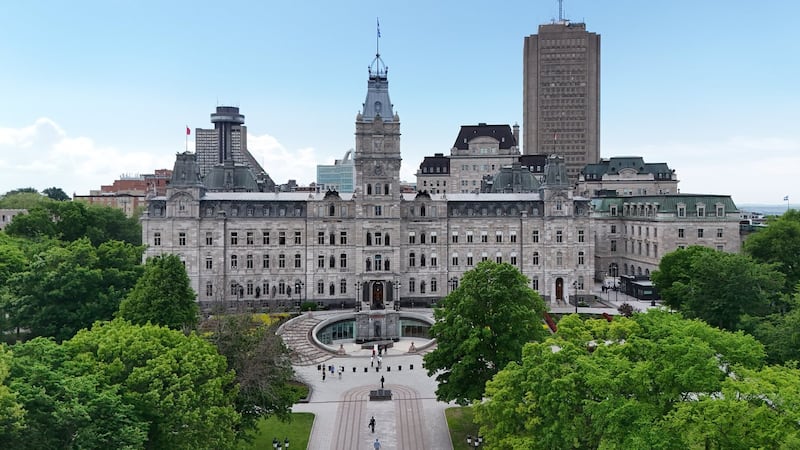
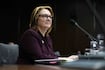
A number of doctors travelled to Quebec City on Tuesday to confront Health Minister Christian Dubé on Bill 106, which would link up to 25 per cent of physicians’ pay to their performance. “I’m worried about my patients,” said Dr. Pascale Breault. “If I have to double the number of patients I see tomorrow morning ... that leads to poor quality medicine ... We’re heading for fast-food medicine.” As the consultations on Bill 106 got underway, Dubé reiterated his goal of ensuring all Quebecers have access to health-care professionals by summer 2026. But “it takes a mutual commitment,” replied Dr. Benoit Heppell, who accompanied Dr. Breault, Dr. Isabelle Gaston and the President of the Fédération des médecins omnipraticiens (FMOQ), Dr. Marc-André Amyot, to the National Assembly. “I can do things differently, as the minister sees fit, but we’re going to need a commitment to put resources into the front line,” said Heppell. The family doctor has calculated he could offer 650 more appointments a year to patients if only he had access to more nurses, social workers, psychologists, etc. “Unfortunately, on the front line and in family medicine groups, access to these professionals is inadequate,” he said. Heppell was also keen to inform Dubé that he spends a whole month a year “filling out paperwork.” For her part, Gaston pointed out that not all doctors could work at full capacity. “People say we’re lazy ... You know, sometimes you can’t choose your trials and tribulations,” she said. “I see people doing their best.” “We’re short of two nurses and ... our CLSC closes on weekends ... Where is the government’s responsibility and accountability in terms of access to primary care?” Breault asked the health minister. “It’s bad enough that you’re shuffling your doctors around, but I’m not going to start shuffling my patients around to satisfy your balance sheet,” she added. Proposed law undermining doctors’ morale: unions The FMOQ, like the Fédération des médecins spécialistes (FMSQ), says Bill 106 is undermining doctors’ morale of doctors, which could lead to their exodus. In fact, 22 per cent of general practitioners are over the age of 60. The president of the FMSQ, Dr. Vincent Oliva, also called the government to account. “We’re talking about performance: why aren’t the operating theatres running at full capacity, and why will there be only one operating theatre open this summer for the whole of the Outaouais?” Alongside him, haemato-oncologist Gabrielle Gagnon denounced the working conditions in some hospitals, where patients have to use a bell while waiting for the warning light system to be repaired. Bill 106 was introduced at a time when the government is in the middle of negotiations to renew the framework agreement with the two medical federations. Dubé has not ruled out passing the legislation under a gag order. Legault and the Collège des médecins collide The Collège des médecins warns, however, that linking doctors’ pay to performance indicators would simply be “dangerous” for patients. This quest for “volume” would be to the detriment of time spent with patients, which would be detrimental to the quality of care, particularly for vulnerable populations, the professional association points out. The president of the Collège, Dr. Mauril Gaudreault, told the parliamentary committee that he was particularly concerned that doctors would “miss diagnoses.” He recommended that remuneration should not be linked to performance, that collective responsibility should be extended to managers and other health-care professionals, and that “the denigration of the medical profession should cease immediately.” Premier François Legault said on Tuesday that he found the Collège’s position “surprising.” “There are other provinces that have changed the method of remuneration to include a portion based on the amount of care provided. Why should other provinces be able to do this, and we can’t?” he said in a news scrum. “What’s clear is that if we don’t change the recipe, the results won’t change. If we want an efficient health-care network, we need a new method of remuneration,” he added. “The Collège des médecins is no small beer,” pointed out Québec Solidaire MNA Vincent Marissal. “It’s there to protect the public. Volume, volume, volume ... patients aren’t Hygrade sausage, ... they’re human beings.” Liberals say CAQ is diverting the debate Bill 106 serves only to “divert” the debate, at a time when the Legault government was until recently embroiled in the crisis at Maisonneuve-Rosemont hospital, according to Liberal MNA André Fortin. “The government ... has completely hijacked the debate in the last two weeks ... We’re not talking about hospitals that aren’t being built; we’re talking about an open war between the government and doctors,” he said. Bill 106 introduces several major principles, starting with the collective responsibility of doctors to take on more patients. It proposes that front-line doctors be paid by capitation, on a fee-for-service and hourly basis. Capitation is an amount paid according to the population under care. It would be modulated according to vulnerability criteria (colour-coded) used by the INESSS. If the bill is passed, all orphan patients will be affiliated to a care environment, comprising doctors, nurses, pharmacists, etc. When they book an appointment, they will be directed to the most appropriate professional. According to the government, around 1.5 million Quebecers do not have a regular doctor or health-care professional - 17 per cent of the population. Of these, 590,000 are considered “vulnerable.” This report by The Canadian Press was first published in French on May 27, 2025. By Caroline Plante, The Canadian Press