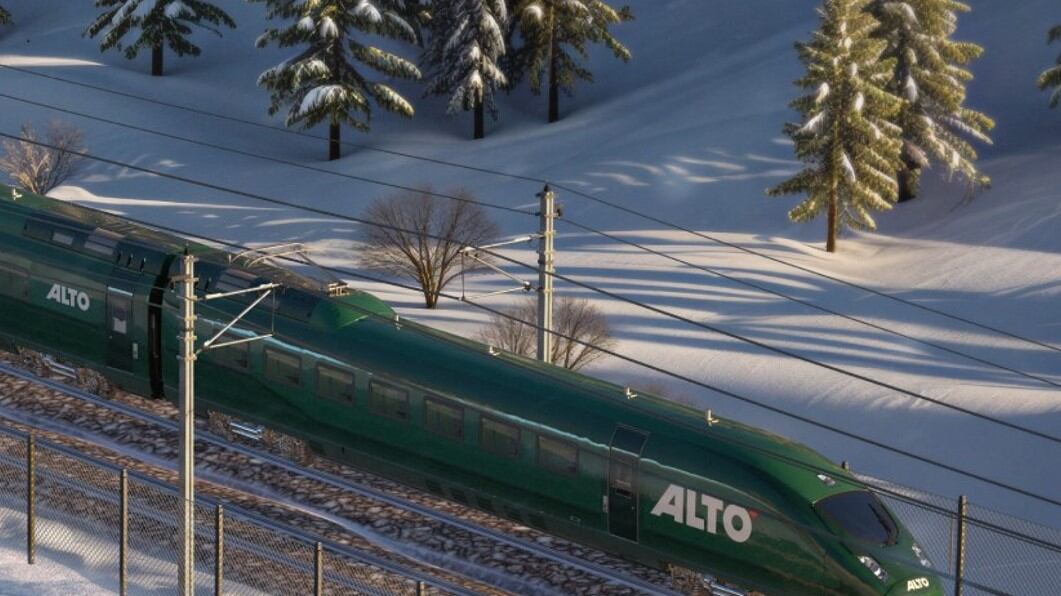
A new study suggests it would be possible to build a rail link between Quebec City and Toronto at a fraction of the estimated cost and environmental impact of the high-speed train project being developed by the Crown corporation Alto, although it would be slower. The study conducted by Vision Transport and agricultural group Union des producteurs agricoles say these savings could be made by modernizing existing tracks. The study was conducted by Vincent Duguay, a master’s student in research at the École nationale d’administration publique, and Pierre DuSablon, an expert with extensive experience in the rail industry. It examines two scenarios: a route serving the same 22 stations currently served by Via Rail, and an express route with stops only in major cities. The authors say a modernized route serving intermediate stations, such as Saint-Hyacinthe or Drummondville, would reduce this time to six hours and 40 minutes, while an express route would take five hours and 50 minutes. Alto’s high-speed rail proposal promises to connect Quebec City to Toronto in 4 hours and 30 minutes. Currently, it takes eight hours and 40 minutes by train to travel from Quebec City to Toronto by rail, which is slightly longer than it takes by car. The study’s authors say their proposed project, while slower, would still be faster than travelling by car. “Farmers don’t want to have their land expropriated only to find out, in the end, that it doesn’t happen because it’s going to cost too much,” UPA president Martin Caron said. ”So, can we look at other alternatives that will have much less of an impact and be much less expensive?” On its website, Alto says it chose to proceed with high-speed rail “based on an in-depth analysis that clearly demonstrated that only high-speed rail can fully meet the current and future mobility needs of the Toronto to Quebec City corridor.” Alto also says the speeds of a high-frequency service would not be enough to prompt commuters to choose to travel by rail instead of driving of flying. The new study includes five major proposals. The biggest and most costly includes doubling existing tracks along the entire route, which would involve adding tracks over 407 kilometres. Currently, 37 per cent of the corridor has only one track, and passenger trains are regularly forced to pull onto a siding to let a freight train pass. The authors say double tracks would also make it possible to increase ridership by operating both an express service connecting only the major cities and a local service serving all 22 stations. The second element of the plan involves upgrading the signalling system to reduce the distance between trains and increase maximum speeds from 153 km/h to 177 km/h, while the third proposes strengthening the Canadian Transportation Agency’s authority to give passenger trains priority over freight. Unlike the high-speed proposal, which would require fencing in both sides of the track and eliminating level crossings, Vision Transport’s proposed train would retain the current 924 level crossings but would require 533 of them to be secured with full barriers. Optionally, it would also be possible to eliminate one-third of the crossings by building overpasses, which would reduce the travel time between Montreal and Toronto by an additional eight minutes. Finally, the fifth element of the plan is to replace the current rolling stock with tilting trains and tracks with steeper bank angles on curves, which would allow them to travel at higher speeds. Alto estimates the cost of the high-speed rail project at between $60 billion and $90 billion. The parliamentary budget officer estimates a cost of $73 billion to $113 billion, while other independent industry sources put the price tag at $150 billion. The modernization project presented by Vision Transport comes in at a cost of $9 billion to $9.4 billion, to which it adds a 20 per cent contingency reserve, bringing the initial cost to $11 billion — a fraction of the Alto project. The alternative proposal’s costs would also increase by $8.2 billion if it includes the cost of eliminating one-third of the level crossings “for reasons of acceptability, coexistence with local residents, and corridor modernization.” With a 20 per cent contingency allowance, the total cost would be about $21 billion. The project’s authors also examined the electrification of the train they are proposing for the modernized line, which would represent an additional investment of $3 billion to $7 billion for overhead wires and rolling stock, for a total of approximately $30 billion. Alto estimates that the cost of a high frequency rail project could be much higher than the numbers cited in the study, ranging from $45 billion to $75 billion. Caron has expressed concerns around electrification, given the difficulties Montreal’s light-rail system has faced with winter conditions. However, he applauds the idea of staying on the existing railroad tracks and rights-of-way on the south shore of the St. Lawrence River. Via Rail does not currently control all of the rights-of-way along its routes between Quebec City and Toronto. “If we’re already using the tracks and doubling them in various places, it’s more accessible to people, and naturally, in terms of cost, it’s much less expensive and will have a much smaller impact on everyone,” he said in an interview with The Canadian Press. Quebec Premier Paul St-Pierre Plamondon has also opposed the Alto high-speed rail development, and campaigned against it before the Parti Québécois was elected to form a minority government. The premier has said it could be a financial fiasco, noting that the Bloc Québécois has estimated the project will end up costing $200 billion. The UPA and its members oppose a route on the north shore, which would involve expropriations of farmland and traffic headaches. Caron recalls the massive expropriations in the 1960s to make way for the ill-fated Mirabel airport project. The airport never caught on with passengers, and its terminal was demolished in 2014. Caron finds it hard to understand Ottawa’s stubbornness when it comes to the project, which he describes as costly and disruptive: “They say, ‘Let’s just go ahead with it, and it’ll cost whatever it costs.’ But I don’t think we’re at that point anymore in Canada — or even in Quebec. Instead, we’ve reached a point where we’re developing projects that can garner social acceptance.” This report by The Canadian Press was first published Nov. 12, 2026. Pierre Saint-Arnaud, The Canadian Press