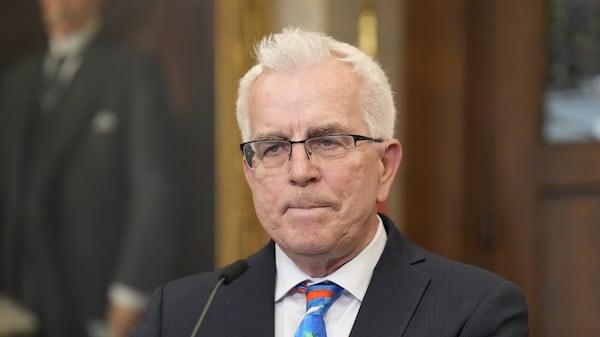
All signs point to Santé Québec, the Crown corporation created by the Legault government to manage Quebec’s health-care system, not surviving a potential PQ government. Speaking Friday at the Montreal Chamber of Commerce, Parti Québécois leader Paul St-Pierre Plamondon highlighted three priorities should he take office next October. ‘Debureaucratization’ One of these priorities will be to prune the bureaucracy, which he believes has become unbearable. In a discussion with Chamber president Isabelle Dessureault, St-Pierre Plamondon said that “the tax reform and debureaucratization initiatives will begin as soon as the term starts... “There is political demand, there is demand from the business community, and we face the impossibility of balancing a budget if most of our resources are spent on bureaucracy. Because we have to understand this: when we create entities like Santé Québec, Mobilité infra, and all sorts of layers, the money goes there, so it doesn’t go to services, and my reading of the situation is that if we don’t correct course quickly, if those resources aren’t dedicated to tangible services for the public, polarization will—rightly so—continue to grow, in the sense that people will express their dissatisfaction at being heavily taxed and burdened without receiving basic services.” Later, during a press scrum, St-Pierre Plamondon did not want to officially announce that Santé Québec’s days would be numbered under a PQ government, but his remarks left little doubt as to the fate of the young state-owned corporation. “If we realize that we are unable to treat cancer patients in a timely manner and that we are unable to care for our young children in school who have learning difficulties, we will have to focus on other, less essential missions and determine how to allocate resources. We’re going to focus on what’s essential,” he said. “When I say we’re going to cut back on bureaucracy and on government apparatuses that were created from scratch by the CAQ, I’m announcing, without a shadow of a doubt, a refocusing on what’s essential, because whatever I can save, I want to redirect toward essential services. (…) The federal government is a striking example. You can create all sorts of agencies and little gadgets aimed at ideological missions, but which contribute nothing concrete in terms of service to the public. So, this is already a reality, and we want to correct it." Pro-business St-Pierre Plamondon also delivered a speech that was well-received by businesspeople, announcing that “a Parti Québécois government will be pro-business. You can repeat that if you like. But we are focused on refocusing our efforts on Quebec’s SMEs.” With this in mind, he promises “an end to the open-bar of subsidies orchestrated by the CAQ.” Denouncing the fact that the overall tax burden on SMEs is 50 per cent higher than the Canadian average and three times higher than in the United States, he promised across-the-board tax relief “on wages, on capital, on profits.” “So, I reiterate today as well that, under a Parti Québécois government, we will become—we have set this goal—one of the most tax-competitive places in North America.” This kind of rhetoric was sure to please business leaders, but the portion of his speech addressing temporary workers certainly did not find such a receptive audience. Replacing temporary workers with robots St-Pierre Plamondon has previously expressed his intention to increase productivity in businesses through automation and robotization. That is why he promises a reorientation of tax credits, “which will now target increased productivity rather than employment.” “We’ve had a labour shortage for years, but look at the tax credits—they’re geared toward hiring staff. It makes no sense,” he said. This is how he hopes to wean companies off temporary labour, through a revision of immigration policies “that discourage innovation because a widely documented macroeconomic reality is that if the labour supply is unlimited, what’s the point—what’s the incentive to automate and rethink one’s business model?” “We’re facing a phenomenon that occurs when population growth is so rapid that capital investments—whether in housing or infrastructure—can’t keep up. And the classic example of this is when cities say, ‘I want to build more housing to address the housing crisis,’ but then the next step in the discussion is, ‘My water system can’t handle building a single additional unit.’” The PQ leader argued that “raising immigration thresholds, according to all serious studies, does not address the labour shortage,” but he was quick to blame the policymakers who opened the doors, not the immigrants themselves: “We have implemented bad public policies, and you will never, ever hear me blame anyone other than those who created those public policies. “So, this isn’t a question of ‘us’ versus ‘them’; it’s a question of us all facing a historic housing crisis that is leaving the next generation with no chance of homeownership, even though they are working harder than their fair share.” This report by The Canadian Press was first published in French on June 5, 2026.