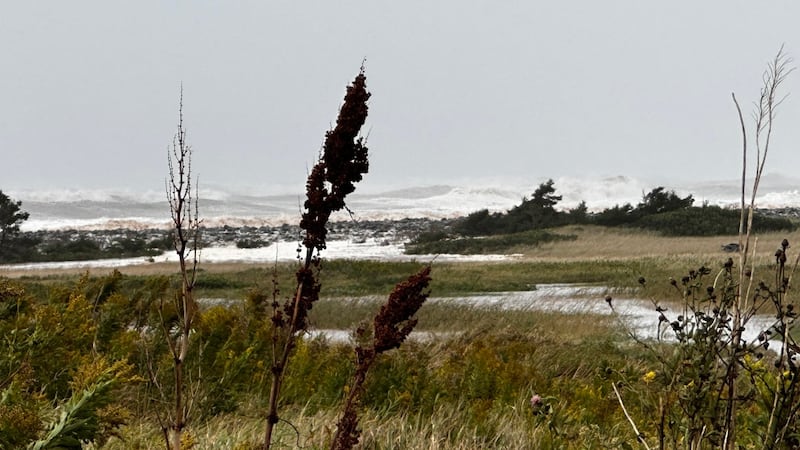
The eroding shores of Lake Huron have put at least 1,755 homes, cottages, and other structures worth nearly $750 million at risk of falling into the lake, according to the Maitland Valley Conservation Authority. “The property values of the buildings that are within the 100-year erosion hazard zone along the Maitland Valley shoreline is $742 million. So nearly three quarters of $1 billion of assets that we all care about. That’s what’s at risk here. So, it’s a big number,” said Pete Zuzek, a professional geoscientist, and expert in coastal geology. Some structures and a road have already had to be moved away from crumbling bluffs along 56 kilometres of shoreline from Amberley to south of Goderich. And, more structures will have to be moved in the very near future due to erosion, said the conservation authority. Some for the second time. “If we just look at the numbers, in the next 25 years, a road will probably be gone, let alone the house. So, before that, the house is going to have to be moved again. That’s what you want to plan for, right? The reality is that I don’t think we have enough money to build a wall to keep that lake from eroding that shoreline. So, it’s going to happen,” said Ed McGugan, chair of the Maitland Valley Conservation Authority. Planned relocation of homes and cottages perched atop Lake Huron’s bluffs is an unpopular topic. But creating a ready to use guide for municipalities to deal with these potentially dangerous situations is one of the main focuses of the Maitland Conservation Authority’s new Southern Lake Huron Coastal Adaptation Strategy, launched in Goderich on Tuesday. “Nobody wants to move. Especially if you’ve got a front row seat. But, you know, we know that the lakeshore is going to erode in time. And it’s just, what do we do about it? You make sure that the people that own the properties are aware of it. And, you know, it’s still their decision to make whether they want to ride it out and just get 10 or 20 years of pristine view, or if they want to protect their investment and take some other forms of action,” said Municipality of Central Huron Reeve Jim Ginn. “That’s something that is not very popular necessarily, because people don’t want to talk about relocation. They want to harden that shoreline or put a big wall up or something. But the reality is, that that shoreline is eroding, and it always has been,” said McGugan. While hardening stretches of shoreline with armor stone and steel walls has temporarily helped some, it’s created worse erosion elsewhere. As part of their Coastal Adaptation Strategy, the Conservation Authority is trying a pilot project that would take the yearly dredgings of sediment and sand from the Goderich harbour and marina and move it south of Goderich to create an erosion buffer or artificial reef at the base of an eroding portion of shoreline, near the 300-home coast development. That pilot project could start as soon as next year. “So, everyone loves to come to the beach for the day and recreate and watch sunsets. In order to continue to do that in these beach environments, we have to work together to restore more natural conditions along the lake. So, this is a great example of how we can move sediment from a place where it’s causing problems in the river mouth and marina basin, and create benefits elsewhere by moving the sediment,” said Pete Zuzek of Zuzek Inc., who is leading the pilot project, working with the Maitland Valley Conservation Authority. “I think a lot of people are watching this in southern Ontario, and hopefully that will lead to more projects like this in the future.” So, will these new measures stop erosion along the Lake Huron shoreline? The simple answer is no, say the experts. The best-case scenario is that erosion is slowed or the pace of erosion is at least slowed along the Lake Huron shoreline. But in the end, nature is going to win. “It’s our moral responsibility to do something, because we know erosion naturally happens. And so, without addressing it, it will only either continue or accentuate. And by addressing it, we can slow it down. We cannot mitigate it to stop. We can slow it down,” said Ashfield-Colborne-Wawanosh Reeve Glen McNeil. “You can’t fight nature. Nature will eventually win. So what are we going to do in the meantime, to try and keep people safe. That is always the number one priority. But also try and protect the investments as best we can,” said Ginn. “I don’t think we have enough money to build a wall to keep that lake from eroding that shore. So it’s going to happen. How do we do that? How do we do that fairly and equitably? The reality is, that we’re not going to stop the lake,” said McGugan. You can learn more online by following this link.