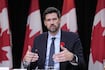
Some post-secondary students across Ontario are fully grasping their new financial reality after the provincial government paused Ontario Student Assistance Program funding at private post-secondary institutions. Earlier this month, Minister of Colleges and Universities Nolan Quinn paused OSAP payments after preliminary findings of a KPMG audit raised significant concerns. In a statement, Quinn’s press secretary Bianca Giacoboni said initial ministry investigations focused on a few schools, resulting in OSAP non-renewals at six campuses earlier this year. “In recent weeks we’ve seen evidence of systemic issues,” Giacoboni said. “At this time, we do not have assurances from the audit team that the issues are not more widespread, leaving us with no choice but to pause OSAP payments to all private institutions to protect taxpayer dollars and hold bad actors accountable.” She added that the ministry understands the decision is creating uncertainty for students. “We are working quickly to develop options for low-interest, third-party loans facilitated by financial institutions to help students through this period of transition,” Giacoboni said. The decision has left 12 of the 27 students enrolled at Emmanuel Bible College in Kitchener wondering what their future holds. “As students, we did exactly what we were supposed to do, and to get this announcement felt like a punishment for a decision we never made, or a consequence for something we felt like we didn’t deserve,” said Gabriel Navas, a first-year student at the college. Navas said he applied for his program in May when applications opened and expected to receive $10,000 to $12,000 to cover his tuition and residence. “I’m taking on another job to be able to pay rent and things like that, and that is not the most optimal thing, especially when I want to focus on my studies,” Navas said. With nearly half the student body facing a similar situation, many are crunching numbers to make up the shortfall. “What I would be using it for is tuition itself,” said Naiya Kang, another affected first-year student. “I have a sister as well who’s also in college, so my parents have a lot of post-secondary costs to manage.” Impact on the college While students are feeling the initial impact of the decision, small institutions like Emmanuel could face long-term financial hardship if students can no longer afford to attend. “We as a bible college are left wondering where close to $157,000 in tuition dollars is coming from,” said Ashley Webber, vice-president of Emmanuel Bible College. “We’ve had our budgets and our plans, and that money is accounted for and relied upon.” Webber added that the specialized nature of their programs makes the lack of funding even more disheartening. “We are seeing students who feel called to step into ministry, and I see the need for pastoral leadership in churches across Canada,” she said. According to a study published in Faith Today magazine in 2024, Canada faces a shortage of pastors due to generational retirements. “We need to graduate 600 students a year ready to step into pastoral ministry. Many bible colleges are really passionate about helping close that gap,” Webber explained. Emmanuel Bible College has operated in Waterloo Region for about 86 years. Its graduates often work in ministry or serve on local and global missions. To try and help the students bridge the financial gap, the college has kickstarted a scholarship, asking the community to help contribute. Ford feels ‘terrible’ for honest students Ontario Premier Doug Ford said Tuesday he feels “terrible” for honest students caught in a system where financial aid is suddenly unavailable. “There’s some good operators there, but caught with the bad apples, a bunch of fraudsters, that is now making sure KPMG is auditing each and every one of them,” Ford said. “We’ve called the OPP in, and I hope to God these bad actors are going to jail.” For some students and administrators, however, Ford’s comments raise more questions than answers. “I feel that when somebody says they feel bad about something and at the same time hold the power to do something about it and they don’t … I think that builds a lack of trust,” Webber said. She added that she wishes the situation had been handled with a scalpel rather than a hammer to target only fraudulent operations. “I was just puzzled as to why there couldn’t have been a reclassification for non-profit colleges like Emmanuel, just to separate us from the punishment that for-profit career colleges are receiving due to malpractice and mismanagement.”