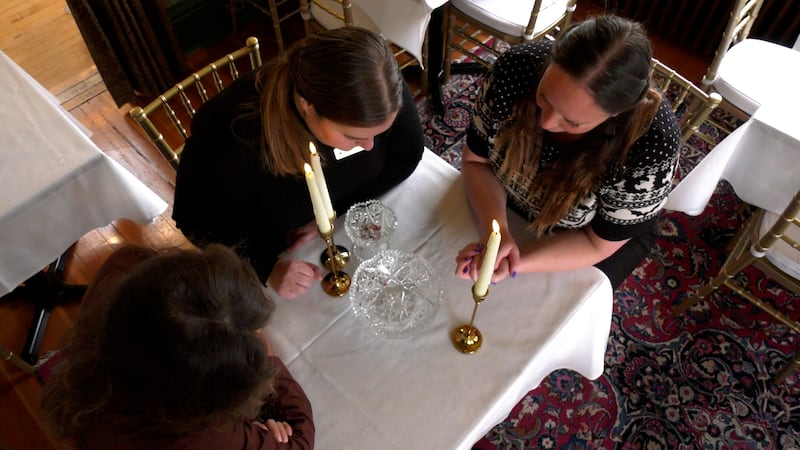
The first sign something was wrong with Aderonke Aderibigbe and Jessie Nguyen’s patient was that he had stopped breathing. He was also unresponsive and they couldn’t find a pulse. Training kicked in. “I’m going to call it,” Aderibigbe told Nguyen before turning to press the intercom to alert the rest of the hospital unit: “We have a code blue.” Then, she started compressions. In the end, the patient neither really died nor lived. He was a digital simulation in a virtual reality, not present in the empty room they stood in, but visible on a screen and in the nursing students’ headsets. But that didn’t stop Aderibigbe and Nguyen from feeling the weight of responsibility for his life. “My heart was still pumping hard,” Aderibigbe told CTV News Edmonton after the practice session was over. She recalled thinking, “Oh my god, I don’t want this patient to die on me.” That is what educators and students alike say is the benefit of new VR technology the University of Alberta’s nursing program began piloting in the fall. Ten months later, they say VR offers unparalleled realism without any risk of causing harm through a training mistake. “If you ever make a mistake, there’s no risk of patient harm,” Nguyen pointed out. In another VR training scenario that day, student Drew Owen was faced with a patient who required medication. “As soon as I put the headset on and the patient started having trouble breathing and his oxygen started to go down, my heart started racing, I started breathing quickly,” Owen recalled. “I was surprised to see how realistic it really did feel and how much it challenged me in the moment to use my critical thinking.” The VR program consists of myriad hospital scenarios, from medication overdoses to illnesses, scaled in complexity to match a student’s level of education. The simulations are also responsive. “If they take vital signs, if they apply oxygen, the patient’s state can change, as well, which allows the students to see in real time how their nursing interventions have actually benefitted the patient,” explained How Lee, a teaching professor and a registered nurse of 20 years. “The more that students are able to learn and build their knowledge base and feel comfortable, it helps with overall patient safety.” Importantly, the simulations give students an opportunity to apply what they’ve learned in the classroom, said Tracey Stephen, a nurse and executive director of the U of A’s Nursing Simulation Centre. “Critical thinking, clinical decision making, clinical judgement, prioritization of patient care – those are key pieces of nursing practice that students actually can experience in a virtual reality setting.” This is important, because they can’t know for sure when a certain set of circumstances will come up in the real world. Since September, 900 students have used the technology and Stephen is working on how to expand its use in the faculty. With files from CTV News Edmonton’s Nahreman Issa