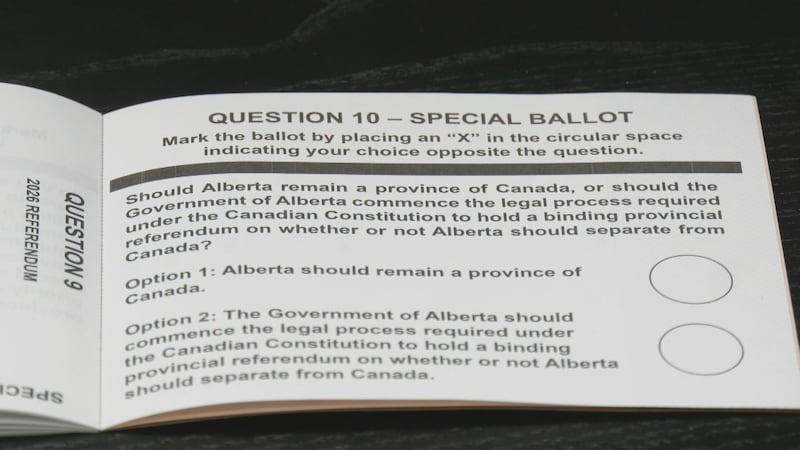
Michael Solberg, a partner at New West Public Affairs, former Stephen Harper government political staffer, and one of the organizers behind the advocacy group Vote to Stay, speaks to Alberta Primetime’s Michael Higgins about the group’s work to garner support for the province remaining a part of Canada. This interview has been edited for length and clarity. Michael Higgins: Vote to Stay hit the ground running immediately in the wake of the premier’s address last week. What’s motivating that rapid response? Michael Solberg: There’s obviously been public policy discussions around citizen-led questions that could be put forward as part of the referendum on Oct. 19, so we have been planning this for months because we thought it was of crucial importance that once this period opened and we knew that we were charging forward with a question on separation, that we were ready to go. There is much more to come, but we thought it was of crucial importance to not waste any time and to make sure that we are ready with a group of dedicated Albertans and Canadians to start speaking to our colleagues, our friends, and our neighbours about the importance of this issue, and frankly, the importance of staying within the Confederation and making that case directly to people. MH: How does the potential for economic impact weigh into the equation from your side of the coin? MS: Enormously. In fact, I think that will be one of the primary drivers behind the message that we delivered to our fellow Albertans. Look, nostalgia is not just the strategy here, there’s real economic implications to this question. Even the notion of separating could have detrimental economic consequences to this province, to the economy that we rely on, the industries that we rely on, the market uncertainty that it would create – let alone the constitutional chaos that could ensue should this go the wrong way. So we intend to make a very strong economic case for why we should stay, and why, frankly, our prosperity and our position and influence in the country is in fact growing right now. I think there’s optimism for a future that we are on right now, which could be disrupted and destroyed through the notion of separation obviously, god forbid, if we follow through with something more legally binding and constitutionally binding. MH: How necessary is it for the actual referendum question itself to be posed in the first place? Do you support the question being asked? MS: I’ll hesitate to even speak to that. The horses are now out of the gates. There’s no turning back on that now, and we’re not in a position, nor do we exist to convince the premier to either amend the question or not ask the question at all. We’re here to mitigate the risks of the question being asked at all, which is what’s occurring. MH: As pointed out, your organization comes from the conservative side of the equation, so how worried are you that this referendum could serve to divide conservative politics in this province? MS: I think that’s already begun. This fight is broadly amongst conservatives, are the ones who are driving this, and they’re almost entirely the ones who are composing the groups that want to leave Confederation. But make no mistake: progressives are involved in this, too. This is a provincial conversation across the board, and frankly, it’s a national conversation as well, which is why we’re welcoming voices from outside of the province, too. It has implications for people all across the country, should Alberta decide to leave. So, you’re right, this is a conversation amongst conservatives, and it has split them really in half, but we’re not the only kind of cohort of voters here who are affected by this, so we’re going to be welcoming and having conversations with people from across the political spectrum, and frankly, from coast to coast to coast. MH: Among the notable names already leading your charge are former MP Monte Solberg and Jason Kenney, the former premier. Two stalwarts who were also within the Harper government. So what’s the likelihood the former prime minister Stephen Harper emerges as a proponent for your group? MS: We would love to have the former prime minister weigh in on this. He has enormous credibility amongst conservatives. He’s a born and bred Albertan. He still lives here. But I will point to, as well, that Stephen Harper, Monte Solberg, Jason Kenney, these are former Reform Party MPs as well, before they were Conservative MPs, and I hope that my fellow Albertans understand the significance of who started their political careers under the onus of the “West Wants In” to the implications of now leaving Confederation, and they’re in their staunch position that we do not do that. MH: Multiple groups, parties, and organizations are already emerging now. Do you look past all the political partisanship to join hands in alignment on the pro-Canada side? MS: Unfortunately there are rules against working with other third-party advertisers. We’re all governed under the same legislation, which actually bans collusion between each other, so we can’t share money, we can’t share resources, we can’t share data, we can’t share lists, but we certainly do wish them well. And I will also point to if we’re all decided to work together under one (third-party advertiser), we’d be really handicapping ourselves in terms of fundraising ability, as we can all only raise and spend $607,000 each, so everyone has to pick a lane and stay within it. MH: Are you concerned at all that multiple voices, multiple pro-Canada efforts, could muddy the waters and drown out the message? MS: Not at all. You know, we all exist here to make a case to stay, and I don’t, frankly, concern myself with how somebody gets to that decision, so long as they have reached that decision. MH: To what degree are you prepared to target the hardcore separatists with your messaging? Is that your target audience? MS: I wouldn’t say so. Traditional campaign strategy dictates that people who already put their feet in the mud are not going to be your typical accessible voter. We’re targeting, I think, the people on the soft separatist side, people who are angry at Ottawa, but we want them to understand that there are reasons to stay, and that voting to leave is not a good message to Ottawa, and it carries too much risk. So, no, we’re going to be courting people who we want to vote, and who already planned to, but make sure that they ultimately do, because we want voter turnout to be very high, and we want it to be high on the remain side. So, no, we won’t be targeting the hardline separatists, so to speak. I think they’ve made that position clear. We’re going to be targeting people who have yet to make up their minds and make sure that they get to the polls.