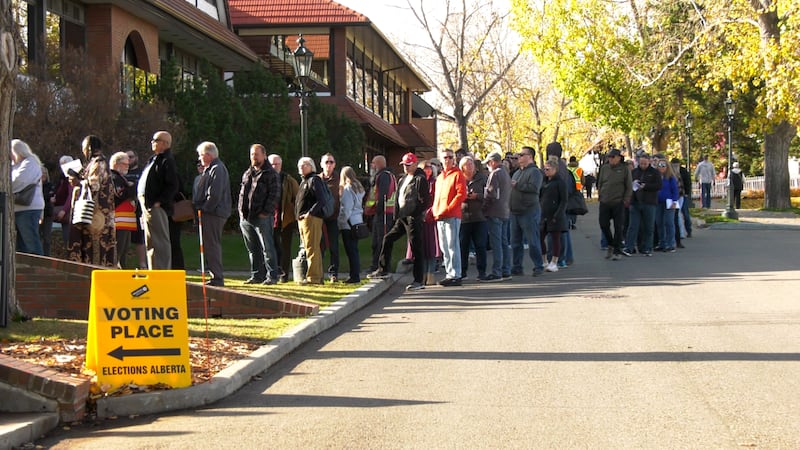
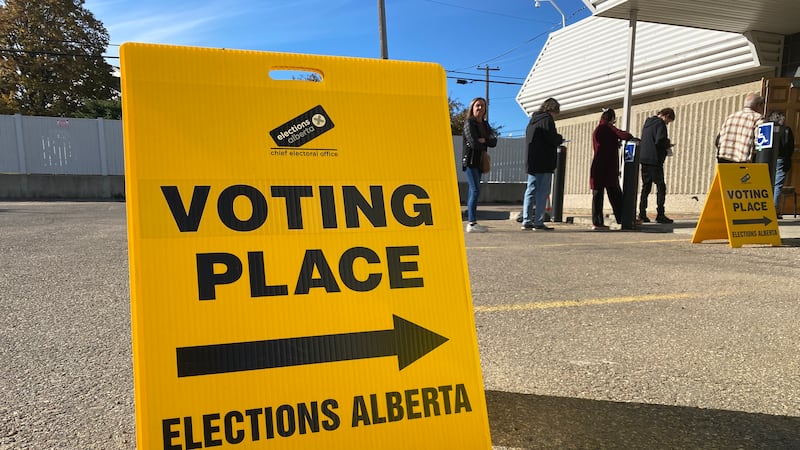
The mayors of Edmonton and Calgary are encouraging residents to get out and vote in the referendum as advance polls see long lineups. This interview has been edited for clarity and length. Michael Higgins: Mayor Farkas, we’ll start with you. What do you take away from seeing Calgarians already in lengthy lineups for the advance polls now that those polls are open? Jeromy Farkas: It shows a desire to participate. And it’s not just the referendum question on separation, it’s also on the other questions around immigration. It’s a broader conversation that we’re able to have as a family, as Albertans. Regardless of your opinion on the matter, get out and vote, get out and participate. I’m certainly going to continue to advocate for Calgary being at the centre of a strong and united Team Canada. And to vote to remain is not to endorse the status quo, but it’s to lean in to do the hard work, the heavy lifting to actually fix our country. Both the former premiers (Jason Kenney and Rachel Notley) really deserve kudos for putting aside their partisanship and really focusing on what’s best for Alberta at this point in time, which is to be, again, at the centre of a strong and united Team Canada. MH: Mayor Knack, how engaged and how motivated do you expect your residents are in this conversation? Andrew Knack: Very engaged. I’m already seeing the posts and the social media comments about long lineups for advance voting, and that’s encouraging. If you had asked a couple of months ago, there was a worry that people were going to be complacent, that people weren’t going to be involved in this very serious issue. So to know that we are seeing that type of turnout, to know that there’s that type of support to get out and be engaged, it’s what we needed for such an important topic. MH: Mayor Farkas, how satisfied are you with the messaging and the actions of the Smith and Carney governments with less than a week remaining? Are they doing enough? JF: I think we can always be doing more. I appreciate the fact that the prime minister is going to be coming down to Calgary and to Edmonton in the next couple days. I really would like to see that final blitz from the premier. I know that she spoke at a closed-door meeting amongst a very separatist-friendly crowd. I don’t want to judge that, I think it’s important for us to go on the offense and make the case. But both the PM and the premier have spent significant political capital to advance the best interests of our province and our country, and that means that they’ve been getting some slings and arrows from their respective political bases. I think it’s good that they’re putting the good of our province and country ahead of partisan issues, but it’s a lot easier for the prime minister, as arguably Alberta’s most popular politician today, to advocate for that. But I’d like to see a bit more heavy lifting from our premier. MH: Mayor Knack, what’s weighing most heavily on you in these final days ahead of the referendum? Or is it all smooth sailing from your perspective as mayor of Edmonton? AK: Obviously there’s still uncertainty, these last few months have created a lot of uncertainty for our cities, for our province, for our country. And what keeps me up at night (is) that might continue after Oct. 19, which is why I am glad to see so many people engaged because the polls have shown overwhelmingly that Edmontonians do not support separating from Canada, and if they are actually getting out to vote, then that voice will be heard loud and clear. But I want to make sure that we can put this behind us and then work together on building a stronger country together, because we do that by working and building a stronger Edmonton and we do that by building a stronger Calgary. When you have that uncertainty sitting in the background, that creates division, that creates challenges, that creates economic uncertainty, and we don’t need that at a time of an unstable world. We need stability, as much stability as we can offer here locally and provincially and nationally. MH: Mayor Farkas, what are your expectations for what happens if Albertans end up voting to send the question of separation to a second, binding referendum? JF: I’m not going to engage in hypotheticals, but I’ll say the real harm that this debate has already caused here in Calgary is about that conversation over who is “a real Canadian” or “a real Albertan.” A lot of my attention is really on the other nine questions, which I think, in different ways, send a signal that we’re not a welcoming community, that we’re not open for investment. So I would strongly encourage Albertans voting on the questions to educate yourself, to do that research, to talk to your neighbours. My hope is that we do send a signal that no matter who you are, you are welcome here in this city, in this province, in this country, and that is the signal that I’m hoping that our neighbours will send. MH: There is another issue riding high that is on the radar for you both, one regarding the Smith government’s intervention in municipal zoning bylaws. Mayor Knack, I’ll start with you first here, your council has been told to turn back the clock on infill development. How far are you prepared to push back? How likely is this to end up in the courts? AK: That’s the important question before us because this isn’t about infill or about transportation planning and bike lanes or about libraries. Mayor Farkas has talked about this quite a bit, this is about how the government is supposed to work. We are required to go into a public hearing with an open mind, and yet we’ve been issued a directive, which isn’t yet in writing, that we have to roll things back. So it’s putting ourselves, I think, in a position where every member of council could be in violation of the Municipal Government Act in either direction. Either we violate the directive, at which point the minister has the ability to remove counsel, if they so choose to go to that extreme. But, if we go into the public hearing and then we vote how they want us to vote, we’re potentially in violation of the requirement to have an open mind. So that to me is the biggest legal question to answer before we worry about the specifics of anything else, the fact that this wasn’t considered or thought about is really troubling, and that’s what we’re going to be discussing as a council on Friday about the legality of this. MH: Mayor Farkas, your council previously repealed blanket rezoning, but to read columnist Rick Bell, you’re angry, vein-popping angry, saying that Danielle Smith is not going to tell Calgary city council what to do. What’s driving your response? JF: I’m not angry, but I am disappointed that this is her closing argument in the days just before us having this momentum decision – punching down, picking fights with municipalities on bike lanes, on banning books, on noise bylaws. It’s disappointing when we actually want to get stuff done. So, not angry, just disappointed. Overreach is bad when Justin Trudeau does it, it’s bad when Danielle Smith does it, and I would be pushing back just as hard if a Conservative prime minister was doing it or if an NDP premier was doing it. If you give this power to a Premier Smith, it’s a power that, say, a premier Nenshi could use to force blanket rezoning on communities. So, let’s not legitimize this. The bigger issue is that it’s not just about land use or density, but it’s also about some of the promises that the provincial government has made around these mega AI data centres. There are local councils who have been reluctant or even opposed to granting those land uses. So, if Calgary and Edmonton are forced into submission in this way, then it’s going to spread to other rural communities who will be forced to comply with these directives that, for the reasons Mayor Knack said, are patently illegal. You cannot threaten or bribe a judge going into, say, a trial, and the same premise applies for elected members of council. Just because the premier agrees with my vote on repealing blanket rezoning yesterday does not mean that she gets to order me around for my next vote. And this is something I would say to an NDP premier, a UCP premier, anybody. I report to Calgarians, not to out-of-town, out-of-touch politicians.