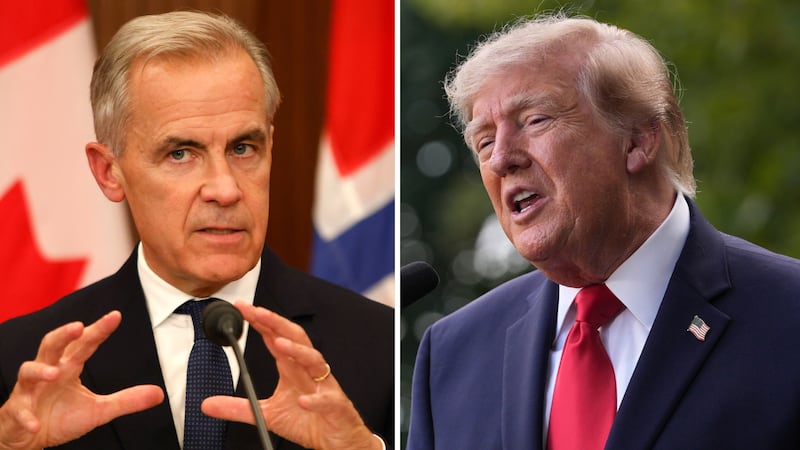
Sabrina Grover, Liberal strategist and former federal candidate in Calgary-Centre, discusses Canada’s tariff negotiation strategy with Alberta Primetime host Michael Higgins. This interview has been edited for length and clarity. Michael Higgins: Our premier has been calling on Ottawa to reopen negotiations before the counter tariffs take effect, and in her words, risk further escalation of the trade war. How do you rationalise retaliation? Sabrina Grover: It’s interesting that she’s the lone chorus of voices with the premiers. For the countermeasures, realistically, the reason why we are doing them is to keep Canada’s economy competitive under the threat of these 50-per-cent tariffs. Canada had been at the table. Canada had almost negotiated a full deal on Wednesday and Thursday of last week. Then on Friday, the United States said, “OK, but just a little bit more.” I think for Canadians and Prime Minister Carney, there is no just a little bit more. We are a sovereign country. We have certain things and certain obligations to our own citizens or own businesses, and that was just too much. And so I think that the countermeasures are not to punish the United States; they are to keep our businesses and our industry competitive. And I think that most Canadians support them. MH: There is support for workers and businesses, but is there not also the risk of consequences for consumers? Retaliatory tariffs will make life more expensive for Canadians generally. SG: I think that that’s true, and I think that overall, the trade war over the last 18 months has made life both more expensive for Canadians and somewhat unpredictable for Canadians, certainly, when it comes to their jobs. But if you look at how Canadians are polling right now, the public opinion and the mood of Canadians is strongly with Prime Minister Carney. I think that that is important. We cannot have restrictions on our ability to do trade negotiations with other countries, and I think that (was) a significant, in the words of Mark Carney, poison pill that was inserted into the last-minute trade negotiations. And I don’t think Canadians want that. This is not a deal at any cost. This is not a deal to restrict our ability to engage and negotiate with the rest of the world. There is a deal that could be on the table. Canada had one on the table, but I think that Canadians are still on side. I do think that the federal government, though, is going to have to make – in addition to the the business support measures that we’ve put forward to keep businesses afloat – some more general consumer-facing mechanisms on affordability, and we’ll probably see those when we get back to the house and in Budget 2026. MH: There are notable voices like former premier Jason Kenney questioning why Canadian energy is not being used as a point of leverage. Is oil truly off the table? SG: That’s a question for Premier Smith. Prime Minister Carney has actually been quite amenable and cordial with Premier Smith on keeping energy off the table. You’ve seen Doug Ford call for it not just in the last week, but he’s called for it multiple times to be put on the table over the many several months of negotiations, including potentially putting Ontario electricity on the table. It is a massive bargaining chip, but it is also a potential huge risk for Alberta’s industries and large Canadian businesses in general. You can never say never in politics. You can never say it’s always going to be off the table. But I do think, for now, it is because if you look back on Wednesday and Thursday, we had negotiated a deal that was acceptable to Canada without using energy as a leverage. And the United States is the one that came to the table and ended that deal because of additional points of leverage that we had never discussed on matters that had already been settled. And so I think that’s where the problem comes in. It’s more about seeing how does this land domestically in the United States? That’s a question we should be asking, as well. As much as it’s unaffordable for Canadians, life is also unaffordable in the United States. MH: What’s your read on the health of Team Canada and the alignment of all the premiers? SG: Despite Premier Smith’s statements today about getting back to the negotiation table, I would say in the last week she’s probably proven to be the most amenable to Team Canada approach as we’ve ever seen. But I do think that it is clear that the United States understands, and the negotiating team there understands that we have regional differences, and it is somewhat regrettable that some of these regional differences are being played out in the media as opposed to behind closed doors with (the federal government and premiers) meetings or with the Council Federation. So I think that there is a risk to continuing to have a lot more public engagement on this without a unified message from premiers. But at the same time, I do think that most premiers across this country have stuck with that Canadian mood that we’re not interested in a bad deal. That we’re going to walk away from a bad deal, and we’re not going to hamstring Canada from future economic and trade negotiations. MH: What is your biggest takeaway from reaction south of the border? SG: What’s really interesting is that you’ve seen in the last, let’s say, even say six months, it’s not just Democrats in the United States that are speaking out against Donald Trump’s policies towards Canada. It is increasingly Republicans. Doug Ford made reference to this in his commentary this week as well, that where this is hitting the hardest is red states. And life is getting extremely unaffordable there, not just as a result of tariffs, but also as a result of additional domestic policies, whether they’re related to agriculture production, health care, any of these pieces. And so I think that that is starting to create a compounding effect in the United States. We may say he’s thrown away the midterms a little bit; maybe he doesn’t care about them. But realistically, having a break with the GOP in the United States, and having not just non-MAGA Republicans come out and speak against this, but even MAGA Republicans or former MAGA Republicans, you’re seeing significant breaks in the U.S. social fabric. Just as they’re watching our regional divisions, I think it’s important to see what happens in their regional divisions, as well.