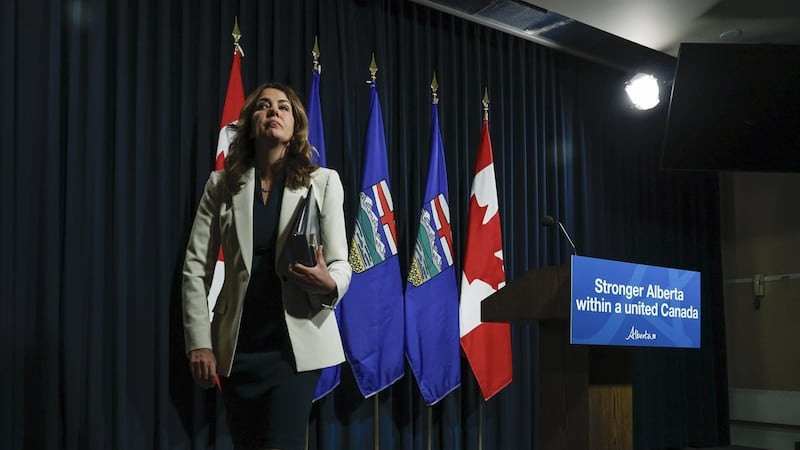
Amid ongoing controversy surrounding Alberta’s ministerial order to remove sexually explicit books from school shelves, and a recently announced pause in the order, many are left wondering what constitutes “sexual” or “explicit.” On Tuesday, the province walked back a previous order from July, which directed school divisions to ban books containing images, illustrations, audio and written passages with sexually explicit themes. The order is now being changed, Premier Danielle Smith said, to only target material containing sexual images after Edmonton Public School Board (EPSB) flagged hundreds of books. At a news conference Tuesday, Smith said she had hoped schools would know how to identify pornographic images without banning classics. But Mount Royal University political scientist Duane Bratt said there’s no clear way to define pornography under Canada’s Criminal Code. “The premier has said, ‘We want to ban pornography and we want to keep the classics, and it’s common sense to know the difference,’” Bratt told CTV News Edmonton on Wednesday. “Well, common sense is one of those terms people throw around to mean everybody should think the way I think.” That’s precisely the challenge the Alberta education and childcare ministry is now up against, Bratt explained. Bratt used Ayn Rand’s The Fountainhead, which appears on EPSB’s flagged list, as an example of a classic that still meets the standards of the original ministerial order, albeit only having a few explicit paragraphs in a 750-page book. He noted that the four graphic novels Smith’s government initially flagged in the order deal largely with LGBTQ2S+ themes. “You look at some of those graphic novels, and it’s a 200-page book with two problematic images. What about the context of the entire book?” Bratt countered. Bratt, however, argued the initial order was so “sweeping” that it sent interpretations overboard, with little definition available about limitations for classics dealing with challenging matter. “Well, what did you mean? You have to write that more clearly,” he said. “This is why governments in the past used to not micromanage individual books. They relied on librarians and teachers to do that and to make sure it was age-appropriate.” He added that the order opened the door for broad generalizations about age and which content could be available in schools that are, for example, kindergarten to Grade 9 – arguing that a younger student doesn’t have access to the same books older ones do anyway. “It’s like saying a six-year-old has access to 7-Eleven but can’t buy cigarettes. There are barriers,” he said. ‘This is about trust’ Smith and her government paused the order on Tuesday and announced they would be rewriting it, calling EPSB’s move “vicious compliance” and accusing school divisions of misunderstanding the government purposely. “This is about trust,” said John Hilton-O’Brien, executive director of advocacy group Parents for Choice in Education. He said he believes EPSB’s pulling of classic literature was a stunt, like “when a kid tries to twist an adult’s instructions.” “Parents expect schools to protect kids from graphic sexual material, and it’s a responsibility we can all agree Edmonton Public tried to dodge.” Parents for Choice in Education is a non-profit advocacy group and one of the groups that met with Education Minister Demetrios Nicolaides last year to discuss concerns about graphic content. “Our original worry had been that the government would ask school boards to do too much or pull too many books. Instead, they were restrained. We didn’t quite expect a school board to try to turn it into a hassle,” he said. Still, Hilton-O’Brien acknowledged that Smith letting off the gas is all part of negotiations. “We’re also against having some of these books banned … But there are books that we probably shouldn’t stock in libraries. These are not innocent books,” he said. In an updated statement to CTV News Edmonton, the education ministry said they were “currently working on a new version of the ministerial order and will not be commenting about specific changes at this time.” With files from CTV News Edmonton’s Evan Kenny, Nicole Weisberg