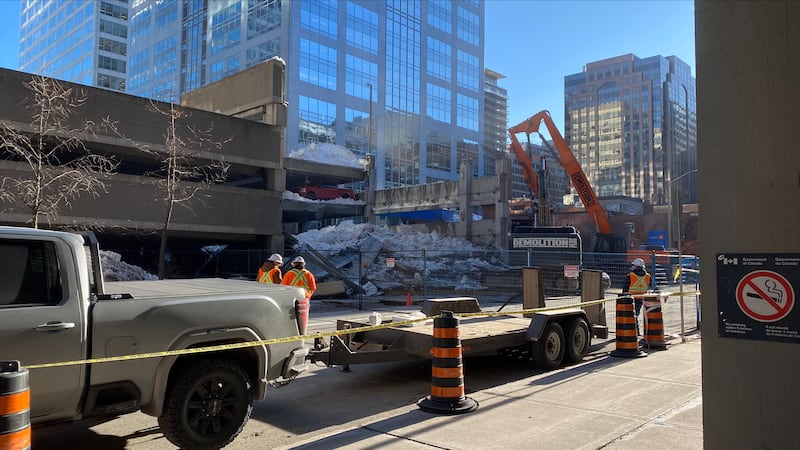
Flooded basements and swarms of mosquitoes aren’t the only major problems being touched off by excessive rain that continues to fall on the city. The record rain is also affecting Edmonton’s infrastructure, including roads, sidewalks, overpasses, underground pipes and bridges. Edmonton saw 264 millimetres of rain fall in June, breaking the 112-year-old record of 216.5 millimetres, and has had 180 millimetres fall so far in July. Edmonton’s wettest month on record is July 1901, when 283 millimetres fell on the community that became a city three years later. Several places have been affected: And those are just a few examples of what’s been occurring across Edmonton, each that has its own challenge and potential solution. One common obstacle in each case is wave after wave of water that’s keeping them from drying out. Alireza Bayat, an engineering professor at the University of Alberta and director of Canadian Underground Infrastructure Innovation Centre, says the amount and frequency of rain Edmonton has seen since the beginning of June has had an impact on roads and all kinds of infrastructure. “Roads are definitely impacted with this much rain, and with this frequency, it weakens the roads,” Bayat told CTV News Edmonton on Monday. “All our ground, with (the) moisture, with groundwater rising, and with the type of soil we have, basically the wetness causes the ground to move a bit, so that creates a challenge for infrastructure like pipes, bridge abutments, foundations, all of it ... “What’s going to be the long-term impact? How much impact? Each of those (examples) is specific to each infrastructure and the condition of it.” At 137 Avenue over Horseshoe Creek, city utility provider Epcor tells CTV News Edmonton it’s trying to temporarily solve the issues with the water three weeks after the road first collapsed while working toward a long-term solution. In a statement to CTV News Edmonton, the City of Edmonton said the long-term effects of the rain and damage have “not been fully realized” and that residents should remain cautious on pathways and roads where crews are working. “As full engineering assessments are finalized across affected areas, the city will identify any necessary structural enhancements and coordinate long-term planning alongside our regional and provincial partners,” it said on Monday. With files from CTV News Edmonton’s Miriam Valdes-Carletti