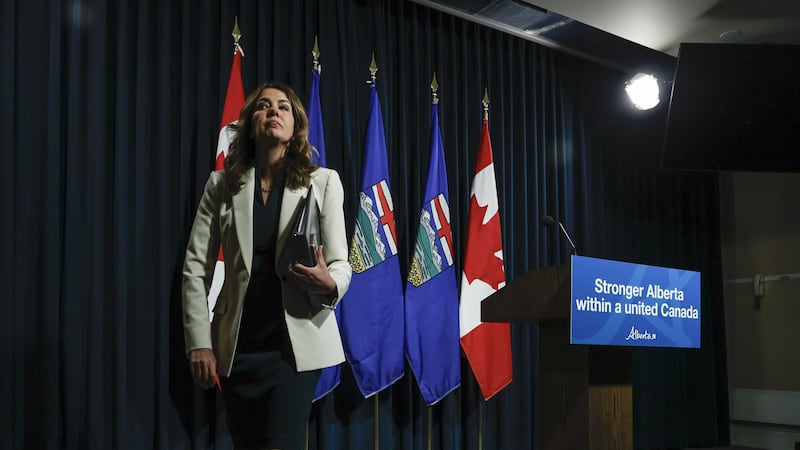
Former Alberta premier and United Conservative Party leader Jason Kenney discusses Danielle Smith’s options for dealing with Alberta separatists with Alberta Primetime host Michael Higgins. This interview has been edited for length and clarity. Michael Higgins: Does Premier Danielle Smith’s paid television address Tuesday night mark the end of the separation conversation? Jason Kenney: Well, Albertans put it to bed. Quite frankly, I’m not sure how it ever got out of bed. I keep reminding people that the separatists have their citizens and they have a right to pursue their cause democratically – and they have, on and off, in elections federally and provincially since 1980, which they’ve contested over a dozen times through about an equal number of parties, and on average getting one to two per cent of the vote, including quite recently, and including at the height of anger towards Justin Trudeau. As somebody who has spent my entire adult life on the conservative side of Alberta politics, I know this terrain very well, and I can tell you that the support for actual independence – a sovereign, separate, Alberta republic, if you will – has never been north of 10 per cent. Indeed, the very accurate Abacus data poll, which nailed the 75:25 breakdown in its last round of polling, also found that two thirds of those voting for option two to begin the process, two thirds of them were voting to send a message or to gain leverage with Ottawa. Only one third, about eight per cent of the province, actually want to create an independent state called Alberta. So this issue never should have gotten out of bed, as I say. And if the separatists want to continue to pursue it, boy, they’re welcome to do so. Back to micro separatist parties. MH: Much is obviously being made of the control separatists have or are seeking to take within the United Conservative Party (UCP). How exposed is the leadership of Danielle Smith at this point? JK: That would be for her to assess, I guess. What we know is this: this separatist movement also always used to be very small. In COVID, something different happened. There was a mobilization of the hard populist and somewhat conspiratorial right, I think, influenced in part by the approach to politics and the style of the MAGA (Make America Great Again) movement south of the border. MAGA seemed to be a vindication of a very aggressive, angry form of populism that was there to burn down institutions, and I think that was a bit of an inspiration. COVID was seen by a small fraction of the public in Alberta as some kind of a conspiracy of globalist elites, academic scientists, media, politicians, you name it, to take away their rights and liberties and permanently do so. That brought together tens of thousands of people who had generally never been before involved in political activism initially to defenestrate me, and then to elect my successor within the UCP. But when COVID went away (and) the convoy was done, I think these folks wanted a new cause. They felt a real sense of moral purpose out of that convoy movement, and they created an ecosystem of organizations. They started raising millions of dollars. They had professional staff. They developed influencers with their own podcasts and alternative media channels. So that whole ecosystem needed to keep going. They felt a sense of vindication, and for them, they latched onto the idea of separation, facilitated by the changes to the citizen initiative law, because they thought that was the best way to separate – not just Alberta from Canada, but in a way from the world, from modernity, … the World Health Organisation, the World Economic Forum, the United Nations, etc. That was the crew – the Mitch Sylvestre, Jeff Rath, Alberta Prosperity Project, and adjacent organizations – that drove this, and they retained the roles that they had gained in the party running a bunch of constituency associations – about half of the members of the provincial board, apparently. And some of them are like a bad cold: They’re never going to go away. MH: It would seem that she’s asking the separatist core to make peace with this, or maybe part ways. Is that the right way to go about it? I believe earlier you were saying purge those ranks. JK: I suppose the language she’s using is a more diplomatic way to say if one of your primary goals in politics is to advance a separate Alberta to secede from Canada, you really don’t belong in a party that A) was founded as a federalist party (I wrote that language in the founding constitution in 2017), B) has been elected to majorities in the legislature twice on a commitment to federalism nationally, C) in a province that has just overwhelmingly rejected separatism. If you cannot accept those facts, then you don’t belong in that party. Now, I think probably more than polite encouragement is going to be necessary. In a Democratic political party you don’t want it to become an echo chamber; there’s got to be space for debate. But on some fundamental points, either a political party stands for certain core principles, or it stands for nothing and is totally incoherent and can’t win the support of voters, consequently. So I think they have to create those very clear parameters. A) I think they need to restore the language that I wrote, which has been removed, declaring it a party in favour of a strong Alberta United Canada. B) They need to do what I did, which is to say, anybody who is advocating for secession will not be a UCP candidate; they will be disqualified. And C) I think they have to look at individual members, and if they’re really militating for this constantly and being a destructive force and disrespecting the democratic mandate of Albertans, they should have their memberships folded. Ernest Manning did this in the 50s. Not to draw an analogy between the nature of this, but he had anti-Semites in the Social Credit Party, and he showed them the door. He fired one from cabinet, people from caucus, blocked them as candidates, threw them out of the party. Parties of the left in the Cold War era frequently had to do this, like labour center-right parties. Social democratic parties had to throw out infiltrators from the communist-Trotskyite-Marxist left. So, every now and then, strong leadership requires that principles be enforced so that there is a coherent party to present to them.