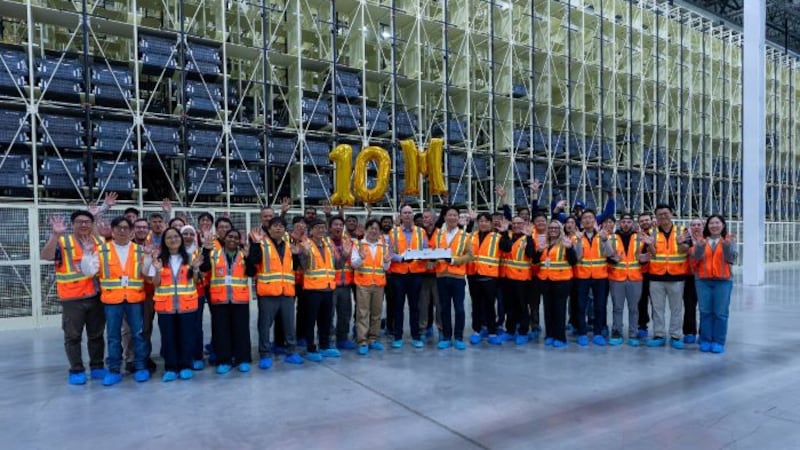
ST. JOHN’S — A company planning a massive data centre in Nova Scotia for artificial intelligence giant Anthropic is in the midst of a dispute about land fees for a failed wind-powered hydrogen project in southern Newfoundland. The Newfoundland and Labrador government confirmed Tuesday that it was still trying to collect outstanding fees from EverWind Fuels for Crown lands set aside for the company’s proposed wind-hydrogen operation on Newfoundland’s Burin Peninsula. But an EverWind official said the company doesn’t owe the Newfoundland and Labrador government anything. “EverWind never signed a Crown land reservation agreement, accepted the province’s proposed reservation fees, or made any contractual commitment to pay the amounts now being claimed,” said a statement emailed Tuesday by Matthew Tinari, EverWind’s chief financial and strategy officer. The company never agreed to the amount of land the province set aside for its project, nor to the terms of the land payments, Tinari said. “EverWind categorically disputes the basis for these charges and rejects the assertion that it owes any debt to the Crown,” he said. The Newfoundland and Labrador government did not respond Wednesday to EverWind’s allegations. EverWind unveiled its plans last week to build a $10-billion data centre in Point Tupper, a community in Cape Breton just south of Port Hawkesbury. Anthropic, the artificial intelligence company behind the Claude chatbot, has already signed a 20-year lease for the facility, EverWind officials said on Friday. The company had previously proposed wind-powered hydrogen energy projects in Point Tupper and on the Buin Peninsula, which stretches out from Newfoundland’s southern coast. In 2023, Newfoundland and Labrador’s former Liberal government set aside nearly 2,700 square kilometres of Crown land for EverWind’s project and began charging the company more than $11.4 million a year — about 3.5 per cent of the land’s market value. But the company didn’t want all that land, Tinari said. It included watersheds, residential properties and community recreational areas, and more than half was “unsuitable for development,” he said. EverWind asked the province several times to reduce the reserve, he said. The government obliged in April 2025, saying it would shrink the area to roughly 1,800 square kilometres, according to letters obtained by The Canadian Press earlier this year through an access-to-information request. They show EverWind officials sending the Newfoundland and Labrador government repeated letters and requests for discussion about the land reserve and its associated fees, though many details are redacted. “There remains a significant amount of uncertainty in this industry, and high-risk development capital is particularly precious in the early stages of these projects,” wrote Sam Imbeault with EverWind in one such email to government officials in November 2023. In October 2024, Trent Vichie, the company’s chief executive officer, wrote to then-premier Andrew Furey and other officials with the former Liberal government requesting an “urgent meeting” about “ongoing Crown land reservation discussions.” There were similar emails from a representative of ABO Energy, a partner in the proposed Toqlukuti’k Wind and Hydrogen Project in eastern Newfoundland. ABO referred a request for comment from The Canadian Press to Copenhagen Infrastructure Partners, which did not provide any comments. In the meantime, Tinari said, the province kept charging EverWind for land it didn’t want. “EverWind made more than $5.6 million in good-faith payments while working constructively with the Province to resolve significant problems with its land reservation and regulatory frameworks,” he said. In February, shortly after a new Progressive Conservative government was sworn in, the province took the land back from EverWind and two other wind-hydrogen outfits, including ABO’s project, saying they were behind in their reserve fees and their developments had stalled. Weeks later, World Energy GH2, a company behind a wind-hydrogen operation pitched for western Newfoundland, filed for creditor protection, saying its project would be worthless if the province took away its Crown lands. Court documents show the company owed Newfoundland and Labrador about $10.5 million in land fees. A provincial Supreme Court judge granted that protection until next month. In the meantime, World Energy GH2 is selling off its assets and trying to refinance. At EverWind’s data centre announcement in Cape Breton on Friday, chief executive Trent Vichie would not discuss the value of the facility’s lease. He said the 18,600-square-metre facility is scheduled to come online late next year. Tony Wakeham, premier of Newfoundland and Labrador, said his province is open to data centres, but he had no regrets withdrawing EverWind’s Crown lands. “I think what we do is we continue to move forward,” Wakeham told reporters Tuesday. “There’s tremendous opportunities in our province when it comes to hydroelectricity, and we’re looking forward to the opportunities for other developments.” This report by The Canadian Press was first published Oct. 22, 2026. Sarah Smellie, The Canadian Press