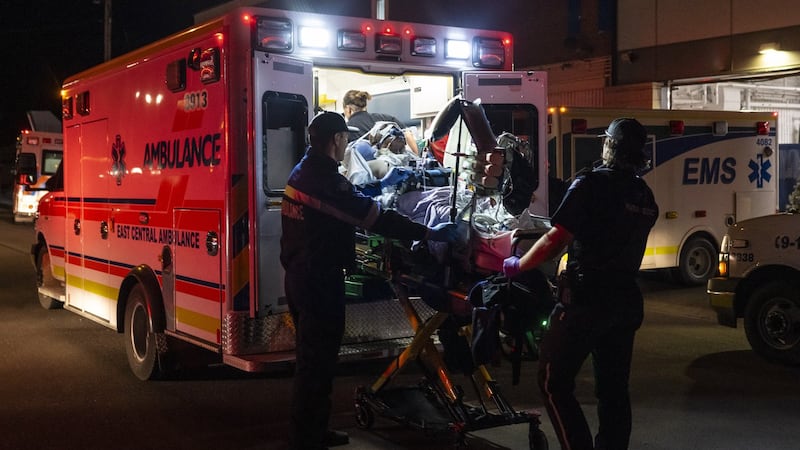
Guaranteed proper cell and internet service is something Manitoba Grand Chief Garrison Settee would like to see on rural and remote First Nations communities across the province. “The lack of adequate cell phone coverage is really problematic because people are not able to contact for help, so it leaves people very vulnerable,” he said. “It’s cost the lives of people and that is a big concern for us.” This message comes in the wake of a mass stabbing on Hollow Water First Nation, about 200 kilometres northeast of Winnipeg. An 18-year-old woman was killed, and several others were injured last Thursday. The suspect, 26-year-old Tyrone Simard, later died when his stolen vehicle crashed with an RCMP cruiser responding to the tragedy. Residents in Hollow Water rely on landlines and Wi-Fi calling for communication, much like other communities outside of urban centres. It appears authorities did respond quickly to the scene, but Settee says the lack of connectivity left residents in danger. “This is a discussion we have been having for a long time,” he said. “Most of the focus has been on urban centres, which leaves our communities, our First Nations at risk.” “In this day and age, there is no excuse to not have the infrastructure to be able to have adequate cellular phone service,” he said. “It’s just a matter of underfunded infrastructure.” Settee says there will be more tragedies in the future, if there is no action, citing safety concerns. “We want to prevent that, and the only (way) we can do that is invest in infrastructure in the North,” he said. Settee has been calling on the provincial and federal governments for years to provide this service to Manitobans living in rural and remote communities. Grand Chief Jerry Daniels of the Southern Chiefs’ Organization told The Canadian Press that First Nations communities, like Hollow Water, deserve connection to emergency services that are the same as what other communities have. He also said in addition to safety issues, connectivity would help economic development and public services. CTV News reached out to Mike Moroz, Manitoba’s Minister of Innovation and New Technology, but did not receive a response back. However, he did tell The Canadian Press that he is working with the federal government, which regulates telecommunications, on improving service. ‘This is not a technical problem’ Joel Templeman says this conversation around access to proper internet and cell service is driven by the fact that internet and connectivity is treated as a commodity and not used for the common good. “The priority is not public safety or public access,” said Templeman, who is the Executive Director of Internet Society Manitoba Chapter. “It still comes down to it being a commercial interest and it costs a lot of money.” Templeman says if the issue was looked at differently through a public safety lens, then the conversation around funding would have to change. “There have been a number of decisions about how we regulate telecommunications and the way that we prioritize connectivity, and the rural and low-income areas consistently lose out,” he said. For Templeman, he has been having this conversation for over 35 years. He says it all comes down to political will. “If we were to prioritize the people and the communities more, then we would probably change the way we regulate things and we would change the way we would apply the technology,” he said. “It’s not the technology’s problem. The access is there. They could and should have this.” ‘We take (the internet) for granted’ Wayne Kelly says this is a national issue. “We have two very different standards in terms of access to that digitalized world,” said Kelly, who is the director of the Rural Development Institute at the University of Brandon. “If we wouldn’t accept that poor quality in 2025 in Brandon and Winnipeg, why should we be asking our First Nations neighbours and our rural neighbours to accept that quality in 2025 as well.” He says 95 per cent of Canadians in urban spaces have access to basic gigabit internet service. That number drops to 80 per cent for those living in rural communities. But when it comes to those living on First Nations communities, he says that number significantly drops to just 61 per cent. ‘There are potential solutions’ Kelly says the community of Hamiota and the RM of Yellowhead in western Manitoba have developed their own broadband service and are rolling it out to a portion of communities in rural Manitoba, including some First Nations communities. “They have been doing that for almost 10 years now,” he said. “When it came out, it was better quality than what you could get in Brandon or Winnipeg, and it was much cheaper.” “It’s not a technology issue. It’s really a regulation and role-out model in terms of how we are expecting service to get out,” he said. Grand Chief Garrison Settee says this summer has underscored the need for proper connectivity in the North, not only with the recent tragic mass stabbing, but with the hot and dry weather that has produced one of the worst wildfire seasons on record, impacting tens of thousands of people right across the country. Settee says updating technology is crucial. “We must press our governments, and we must press our leaders in the country to make sure they invest in the North, because the lives of our First Nations are at risk,” he said. With files from The Canadian Press