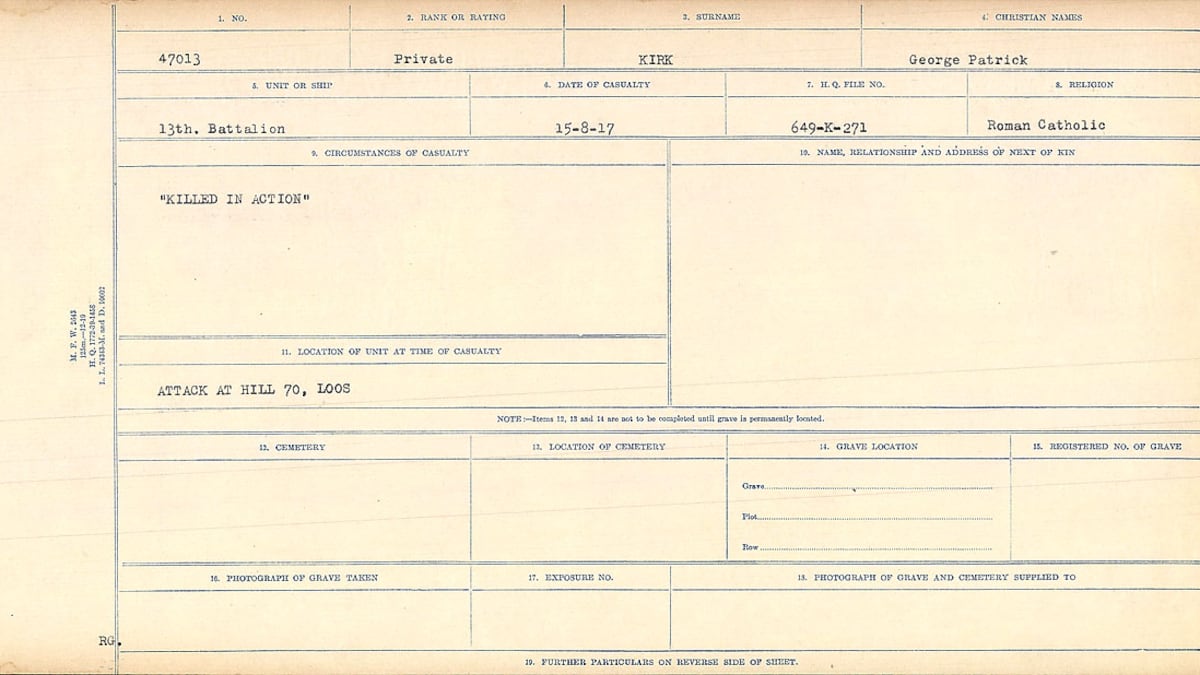
A team of experts working to identify the remains of a Canadian soldier killed during the First World War is hopeful the public can help solve a 108-year-old mystery. In 2016, a set of remains was found near Loos-en-Gohelle, France, a suburb of Lens, in preparation for a new construction project. During the First World War, the area of the discovery was a German trench called Humbug Alley tied to the Battle of Hill 70. The fierce ten-day-battle in August of 1917 killed more than 2,200 Canadian soldiers and left thousands more wounded. Artifacts found alongside the remains include a comb, nail clipper, two coins and a collar badge confirming the soldier was Canadian, and part of the 13th Battalion known as the Royal Highlanders of Canada. Of those killed during the Battle of Hill 70, it’s estimated that more than 1,200 Canadian soldiers still have no known grave. Forty-six are members of the Royal Highlanders of Canada. “For this case, while we don’t have any artifacts that point towards a specific person, our list of candidates has shrunk from the more than 1,200 Canadians missing from Hill 70 to the 46 members of this unit who are missing from that battle,” said Alexandra McKinnon, a Department of National Defence historian with the casualty identification program. A forensic analysis revealed the soldier found in 2016 was in his early 20s when he died and was between 5-foot-5 and 5-foot-8-and-a-half tall. Who could the unknown soldier be? After years of historical and forensic research, the casualty identification team is seized on one soldier in particular, Pte. Patrick Kirk, or possibly Quick or Quirk. The Newfoundland native’s casualty card shows he was killed in action at Hill 70 in Loos on the first day of the attack, August 15th, 1917. Not only is he listed as one of the soldiers missing from the 13th Battalion who fought at Hill 70, but McKinnon says he is about the right size and age. “Private Kirk is on our short list of candidates,” said McKinnon. “He’s in the right place at the right time, or rather, the wrong place at the wrong time, given this context.” The soldier, whose name in historical records has been written multiple ways, enlisted in 1914 after working as a miner in Stellarton, Nova Scotia until the war broke out. Attestation papers show George Patrick Kirk was born in St John’s, N.L. on March 17, 1894, and enlisted in 1914. His next-of-kin is listed as a Mrs. Thomas Quirk who was living in Stellarton, N.S. at the time. So far, however, McKinnon and her team have not been able to reach any of Pte. Kirk’s relatives. The team uses DNA samples from living relatives to confirm the identity of unknown soldiers. Without a sample McKinnon says she can’t know for sure whether the remains belong to Pte. Kirk or another soldier on their short list. “We’re having a bit of trouble tracking down Pte. Kirk’s family,” she said. “We wanted to put this story out there.” McKinnon and her team are asking anyone who thinks the man sounds familiar to register online. McKinnon says registration, which includes the submission of details about yourself and the war dead, will not only help in this case but in the other active cases they are working on. The Department of National Defence’s Casualty Identification Program is currently trying to identify 42 soldiers whose remains have been recovered from across the former Western Front. “The purpose of the Casualty Identification Program is for the dead to be buried with their name by their unit, and in the presence of their family,” said McKinnon. “It’s also commitment to the dead and to their families, that their service and sacrifice is not forgotten.