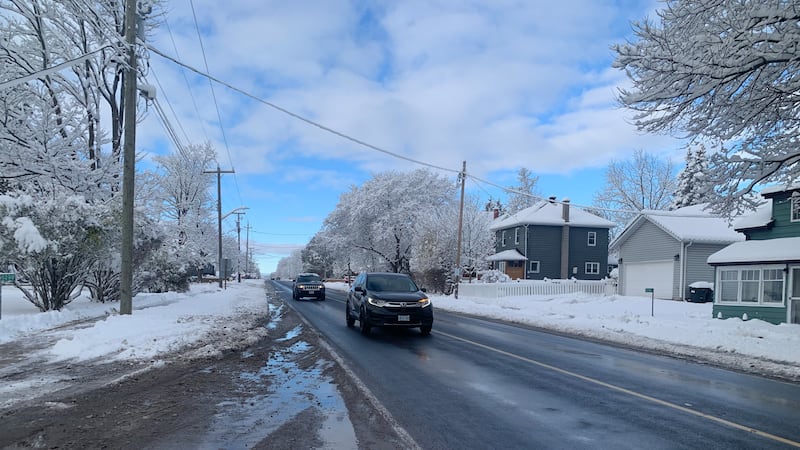
OTTAWA -- Every Saturday for the past six months, Emanuele Fuldauer has stood with a small group at the corner of two rural highway roads in Crosby, Ont., bearing a sign that says “ALTO” crossed out with a red circle, as well as her frustration. “I have given myself to the community and to this country, to the people in it, and to be treated with such disrespect, I find infuriating,” the retired nurse told CTV News. She is concerned her small community of Chaffeys Locks in the Rideau Lakes would be completely cut off if one of the proposed Alto routes goes ahead. She said it is “infuriating” to hear about proposed legislative powers that would widen the government’s expropriation powers, as first reported by CBC. Ajay Gajaria, a partner in the municipal and expropriation practice group at Aird & Berlis LLP, said property owners should be aware of two key area in the new proposal. Both expand powers granted under the government’s High-Speed Rail Network Act, passed in March. That legislation gave the government the right of first refusal for up to eight years, which could put property owners in “purgatory”, with no one wanting to buy their land while it has yet to be expropriated. The new proposal extends the language to include lands “related” to the project, though Gajaria explained the definition of what counts as “related” is not made clear. “So, that could be a significant increase in that power and the ability to register that right of first refusal,” he said. A similar expansion to “related” lands involves the government’s ability to prohibit changes being made to your property for up to four years. A third change Gajaria pointed to would send disputes over the creation of railway crossings to arbitration rather than a traditional tribunal. If the costs are less than $50,000, they are split equally by the parties. That means a landowner fighting for access to their own land via a crossing could pay up to $25,000 to push back. “That’s significant, and it’s going to be interesting to see how that plays out with the right to claim compensation for the diminishment in value to your remaining lands,” Gajaria said. “Taking private property is one of the most solemn things a government can do,” said professor Matti Siemiatycki, director of the Infrastructure Institute at the University of Toronto. He told CTV News that expropriation, “when it’s critically necessary,” needs to be done fairly, with appropriate compensation for losses. Whether these new legislative changes can be done fairly depends on how they play out in practice, he said. Siemiatycki said Alto and the government “should be much more explicit about what type of compensation they’re going to be paying,” and whether that includes compensation for first right of refusal and prohibition of work. “If you want options in a market, that’s something you pay for, he said.” Multiple dynamics around the project have intersected to create a “fever pitch, Siemiatycki said.” “It’s very technical, but it has human knock-on effects, and it also clearly has political ramifications as well.” Siemiatycki is also part of the Policy Innovation Lab, an academic advisory panel funded by Alto. In a statement, Alto spokesperson Marlee Socket for Alto said “fair compensation will be assessed based on the circumstances of each property and farming operation.” “The proposed measures would help us move forward responsibly toward the start of construction in 2029-2030,” Socket said. “A more streamlined process does not mean reducing protections for affected property owners or project oversight.” In Chaffeys Locks, Fuldauer said many of the homes are “eclectic.” Her 88-year-old mother lives next door in a home with multiple upgrades allowing her to age in place. If her mother needs more care in a retirement home, the house was meant to serve as her nest egg - something Fuldauer worries could be tied up by the right of first refusal. Fauldner, who lives with multiple sclerosis, has also renovated her own home so she can live on the first floor if she needs a wheelchair. Although protesting in the cold is physically taxing, Fuldauer said she will continue to do it every Saturday for two hours – the maximum her body can handle. “As an individual, all I can be to Alto is friction,” she said. “And if I can get other individuals to be friction, we can be a big line of friction, and that is truly the one word that keeps going through my head.”