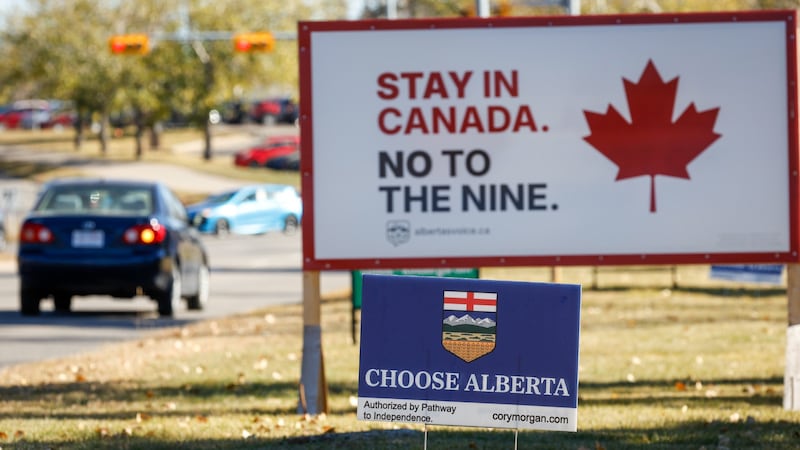
CTV News is your Alberta Referendum headquarters. Live results. Expert analysis. Everything you need to know is here. Albertans voting Monday are deciding whether the province should remain in Canada or begin a legal process that could lead to another referendum on separation. Question 10 presents two choices: remain a Canadian province, or have the Alberta government begin the legal steps required under the Constitution to hold a future, binding referendum on whether Alberta should separate. The result of Monday’s question is non-binding. Choosing the second option would not make Alberta an independent country. How could it lead to another referendum? The provincial government says a majority vote for the second option would prompt it to begin the legal processes necessary to hold a binding separation referendum at a later date. That would mean asking Albertans to vote again — this time on whether the province should leave Canada. The two-step approach follows a court ruling requiring consultation with First Nations about potential effects on treaty rights before a binding separation referendum could proceed. The province is appealing that decision. Premier Danielle Smith announced Question 10 in May, saying the government wanted direction from Albertans while the court process continued. Smith has said she supports Alberta remaining in Canada. Would a second vote automatically mean separation? Even a future vote in favour of independence would not allow Alberta to leave Canada unilaterally. Under the federal Clarity Act, the House of Commons would assess whether a separation referendum asked a clear question and whether a clear majority supported leaving before the federal government could enter separation negotiations. Lawful separation would require negotiations involving the federal and provincial governments and an amendment to Canada’s Constitution. Indigenous rights, interests and territorial claims would also have to be addressed. What does polling show? An Angus Reid Institute poll released Friday found 66 per cent supported remaining in Canada, compared with 34 per cent supporting the process toward a future binding referendum. The online survey of 1,010 Alberta adults was conducted Oct. 13–15. Online panel surveys cannot be assigned a conventional margin of error. For comparison, Angus Reid says a probability sample of the same size would have a margin of error of plus or minus three percentage points, 19 times out of 20. Mount Royal University political scientist Lori Williams cautions that turnout will determine the outcome. “We know that a super majority of Albertans want to stay in Canada,” Williams said, adding that the result will depend on whether those voters show up in sufficient numbers. Polls are open between 9 a.m. and 8 p.m.