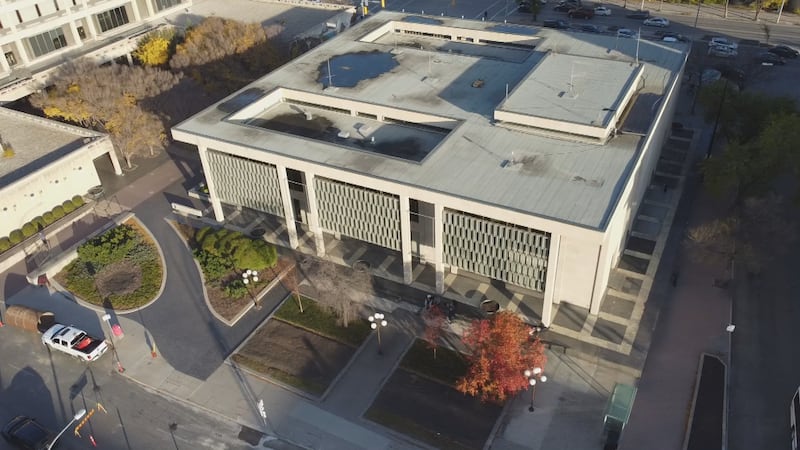
One Calgary Opera patron is questioning when a political protest crosses a line by disrupting the performance itself, which is what happened Saturday night at the closing performance of Tosca. At some point during the show, a group of protesters waving Palestinian flags entered the Jubilee Auditorium shouting “Free Palestine” and waving flags. According to Marilyn Sellar, who was sitting in the balcony, it took a while for the protesters to leave -- although onstage, the performers didn’t miss a beat. “The opera continued. They kept playing. It took four or five minutes to get them out of there,” Sellar said. The protest came in response to a situation last Friday night on opening night, when one performer, bass singer Gabriel Sanchez-Ortega unveiled a Palestine flag at the end of Giacomo Puccini’s drama about love and betrayal during political upheaval in Napoleonic Rome. Sanchez-Ortega played a character named Cesare Angelotti, an escaped political prisoner. Following the incident, the opera company released a statement, calling the action “unexpected and unauthorized,” adding that individual political protest violated company policy. The organization apologized for the “discomfort and distress” some may have felt and said Sanchez-Ortega’s role will be performed by another artist for the remainder of the shows. In an Instagram story, Sanchez-Ortega wrote that he had “no regrets” and that “this is the state of cultural institutions in Canada.” In a statement to The Canadian Press, the Calgary Opera said it prohibits any personal protests on its stages and at its events. “The display of any protest symbol or action would result in similar consequences,” the message read. “We have reiterated this prohibition to all artists and staff, and will continue to apply it universally in response to all cases of unauthorized protest, regardless of the symbol or action that protest takes.” Sanchez-Ortega said he holds no resentment. “After the theatre, (political or otherwise) we all have to go home, and look at ourselves in the mirror,” Sanchez-Ortega continued in his statement. “It was my honour to play the role of Angelotti, an escaped political prisoner.” Sunday, Sanchez-Ortega had a poster promoting the protest on his Instagram page. The poster said, “Bring your flags. Bring your voices. Art is meant to confront power, not submit to it.” Sellar wasn’t entirely unsympathetic to the protestors but still expressed concern about them entering the theatre, where Jubilee ushers -- many of them older -- were tasked with getting them out. “It’s an interesting situation,” Sellar said. “I’m generally a big supporter of people protesting, but to actually go inside the theatre and scare people (in the audience)? “It’s not a normal protest,” she said. “It was very frightening and disruptive. I know they’re having a heck of a time getting people to know (about what’s going on in Gaza), but this was over the line -- to come in there with their flags, shouting.” She acknowledged the irony involved in staging an opera about a political protest and then firing a singer for staging one in real life. “It was the right one (Tosca) to pick,” Sellar said. " I don’t think it was lost on anybody." She added that the political gate crashers might have financial implications for the non-profit arts company as well. “Now the opera will have to pay for security,” she said. A Jubilee spokesperson said all staff and patrons were fine and the performance continued uninterrupted. Statement from Gabriel Sanchez-Ortega Sunday afternoon, Sanchez-Ortega sent CTV News the following statement: “The struggle for Palestinian liberation is our struggle as well. It is the struggle for humanity. It is not my right, or anybody’s right, to tell people how to protest this injustice. I would advise anyone, but my colleagues in classical music in particular, to consider the following words taken from Henry David Thoreau’s essay, Civil Disobedience: “Must the citizen ever for a moment, or in the least degree, resign his conscience to the legislator? Why has every man a conscience, then? I think that we should be men first, and subjects afterward. It is not desirable to cultivate a respect for the law, so much as for the right. “The only obligation which I have a right to assume, is to do at any time what I think right. It is truly enough said, that a corporation has no conscience; but a corporation of conscientious men is a corporation with a conscience. “Law never made men a whit more just; and, by means of their respect for it, even the well-disposed are daily made the agents of injustice.” CTV News has reached out to the Calgary Opera for further comment. With files from The Canadian Press