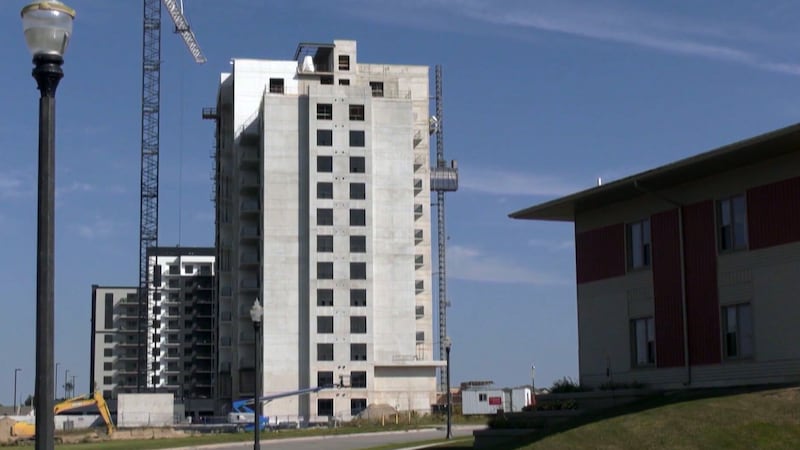
Calgary police officers, along with members of the Canada Border Services Agency (CBSA), attended the city’s event centre construction site on Wednesday for what police described as a “planned regulatory compliance” operation. The Calgary Police Service (CPS) said the activity involved immigration checks and status verifications. Police emphasized their role was limited to ensuring safety while CBSA officers carried out their duties. “The CPS routinely works collaboratively with other law enforcement agencies to ensure community safety during large-scale operations,” the service said in a statement to CTV News. The CBSA confirmed officers were at the scene, describing the visit as part of an ongoing investigation. “When the Canada Border Services Agency becomes aware of situations where there are possible violations of the Immigration and Refugee Protection Act (IRPA), we investigate and take the appropriate action as mandated by Canadian law,” the agency said in a statement. “Earlier today, CBSA officers in Calgary visited a construction site at the junction of 12th Avenue S.E. and Stampede Trail as part of an IRPA investigation. CBSA officers exercised their designated peace officer authorities by conducting ID checks for the purpose of administering and enforcing the IRPA, namely to identify persons of potential interest for non-compliance.” The statement added that given the large size of the worksite, CBSA requested the presence of CPS “as an extra security measure in support of public safety and officer safety.” Construction worker Tamara Watson said crews were told to evacuate before being directed to line up and show identification. “We just noticed that there was a lot of cops and immigration officers, and we were told that we had to grab our IDs and that we would be at the front gate and ID’d and questioned,” she said. “Some returned to work, and some didn’t.” Watson said the surprise inspection created confusion and concern among workers. “As we walked back to work, there was a lot of concern—a lot of people who were mad, some who were on their phones,” she said. “I even messaged my mother. I’m native. I’m from here, and even that worried me. A lot of people here were just in disbelief.” Immigration lawyer Raj Sharma says similar CBSA operations have become more frequent across Canada in recent months. “This is common in Canada, but it’s uncommon in Calgary,” Sharma said. “We’ve been seeing this more and more—there were CBSA raids going on with respect to South Asian construction companies late last year. CBSA has been newly enhanced and newly empowered. They’ve got way more funding and 1,000 more inland enforcement officers. So we’ve seen a shift in Canadian immigration from integration to enforcement.” Sharma says the agency’s actions are often based on intelligence or tips and can have serious consequences for both workers and employers. “A lot of this is based on tips—it could be competitors, it could be unions, it could be CBSA intelligence,” he said. “There could be significant repercussions for employers in Canada that are utilizing unauthorized workers, including fines, and there are consequences for foreign nationals that are not complying with the terms and conditions of their permits.” Jatin Shory, partner at Shory Law LLP and chair of the Canadian Bar Association’s National Immigration Section, said CBSA inspections are typically tied to specific investigations rather than random checks. “If CBSA is showing up, that’s a little bit unique,” Shory said. “Typically, CBSA has some kind of active investigation or some probable cause for why they’re actually showing up on site. I don’t think the CBSA has the kind of resources to be randomly walking into any kind of business establishment or construction site to run these types of checks, so they’d likely have some reason to be there.” Shory noted that large construction projects often involve multiple subcontractors, which can complicate compliance oversight. “In large-scale projects, you may have general contractors who are abiding by the rules, but they are contracting out so much work, I don’t know what checks and balances exist in terms of who they’re working with on the various verticals of completing a project,” he said. Shory also highlighted that CBSA’s increased resources may be influencing a rise in inland enforcement operations. “I think that in suggesting the CBSA is getting more manpower, they’re probably able to act a little bit more efficiently, and so they do actually have the resources to start conducting these types of checks more frequently,” he said. CBSA said the investigation remains ongoing and that border and immigration information is protected under the Privacy Act. The agency also encouraged the public to report any suspicious cross-border activity.