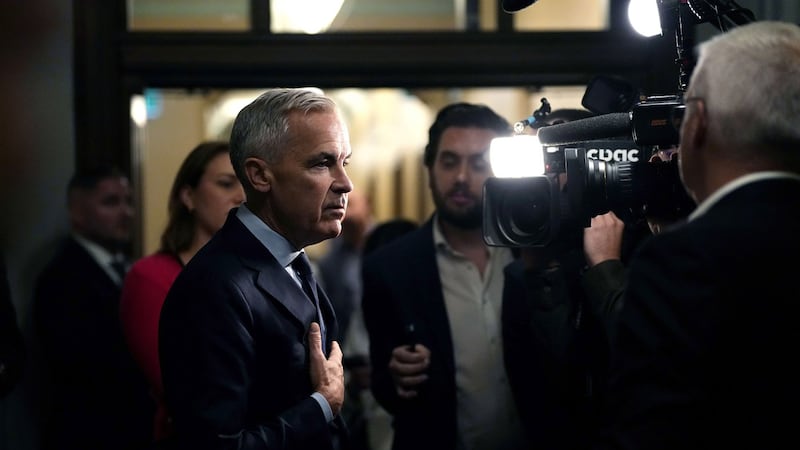
Prime Minister Mark Carney’s Davos speech and U.S. President Donald Trump’s response are sharpening debate in Alberta over sovereignty and trade. In his keynote address at the 2026 World Economic Forum, Carney said long-standing assumptions about security, alliances and economic integration no longer hold. “The old order is not coming back,” Carney said. “Middle powers must act together because if we’re not at the table, we’re on the menu.” Carney didn’t mention Trump by name, but his remarks were widely interpreted as a response to the U.S. administration’s aggressive posture on tariffs, trade and territorial claims—including renewed rhetoric about Greenland and repeated references to Canada as the “51st state.” Trump responded in his own appearance at the forum, directly challenging Carney while discussing the United States’ proposed missile defence system. “We’re building a ‘Golden Dome’ that’s going to, just by its very nature, going to be defending Canada,” Trump said. “Canada gets a lot of freebies from us, by the way. They should be grateful also, but they’re not.” “I watched your prime minister yesterday; he wasn’t so grateful,” he said. “But they should be grateful to us. Canada lives because of the United States. Remember that, Mark, the next time you make your statements.” The exchange struck a nerve in Alberta, where concerns over trade access, national unity and Canada–U.S. relations are already deeply felt. ‘A very dangerous environment’ Rob Huebert, director of the Centre for Military Security and Strategic Studies at the University of Calgary, said Carney’s speech marked a noticeable shift in tone. “It’s a clear identification of the very dangerous environment we live in,” Huebert said. He said Carney avoided Canada’s habit of lecturing allies about values, focusing instead on geopolitical realities. “To hear Carney talk about the real politics we are now facing and what Canada has to do I think shows a maturity we haven’t been seeing,” Huebert said. But Huebert said strong words must be followed by sustained action. “I’ll wait to see before I get too excited about what Carney was saying, to see what he is actually going to do in terms of policy,” he said. Huebert said Trump’s response was deeply concerning. “When he starts talking about Canada really not existing without the United States, that becomes another element of his annexation narrative,” he said. Huebert said Trump’s comments fit a broader pattern. “Trump is doing what he’s saying,” he said. “It may be totally irrational. It may be totally against American security interests. It’s definitely against our security interests. But he’s got follow-through.” Huebert said any internal divisions within Canada could also leave the country more vulnerable. “Any talk of Alberta separation is basically going to weaken Canada,” he said. “And a weakened Canada is the exact opposite of what we need right now.” Separatists seize moment Alberta separatist lawyer Jeffrey Rath said Trump’s remarks exposed a failure of federal leadership and reinforced calls for independence. “Mark Carney is an embarrassment to the entire country,” Rath said. “Donald Trump literally pantsed him on the world stage.” Rath, general counsel to Stay Free Alberta, also criticized Carney’s comments on a “new world order” and his references to NATO’s Article 5, arguing they undermined Canada’s relationship with its closest ally. “This is not leadership,” Rath said. “Mark Carney is an embarrassment, and I think he should resign.” Rath said reaction to Carney’s rhetoric has energized Alberta’s independence movement—particularly among immigrants who fled communist regimes. “They know what Communist China means, and they know they don’t want to be governed by Communist China,” Rath said. “Thanks to Mark Carney, they have been given an impetus to come out and sign.” He said organizers have seen long lineups at petition-signing events. “How often in somebody’s life do you get to create a new country?” Rath said. “It’s an amazing thing.” Alberta’s premier weighs in Alberta Premier Danielle Smith emphasized diplomacy while calling for concrete economic action. “I remain convinced the path to a positive resolution with our U.S. allies is strong and consistent diplomacy and working in good faith toward shared priorities,” Smith said in a statement to CTV News. She said she supports Carney’s efforts to diversify trade but stressed global uncertainty demands urgency on energy infrastructure. “Global events have underscored the necessity to greatly expedite the approval of a million-barrel-per-day oil pipeline to Canada’s west coast,” Smith said. “The federal government needs to act with urgency to seize this opportunity, safeguard long-term economic security, enhance global competitiveness and secure our energy future.” Carney said economic leverage is increasingly being weaponized. “Great powers have begun using economic integration as weapons, tariffs as leverage, financial infrastructure as coercion,” he said. For some Calgarians, that message resonated. “I just felt really proud,” said Sally Carefoot, a Calgary resident who immigrated from the U.K. 18 years ago. “I think he portrayed Canada in a really successful and positive light.” Carefoot said Trump’s remarks should motivate Canadians rather than intimidate them. “Let’s prove him wrong,” she said. “The proof is in the pudding.” Other Calgarians focused on the realities of economic interdependence. “We do have to coexist,” said Kim Heinze. “We’re trading partners, and there are some interdependencies there.” “I think we might have to look at different markets—Europe, South America, Asia, Africa.” he said. “We can’t rely on the Trump administration right now.” Sovereignty in a shifting world In Davos, Carney reaffirmed Canada’s support for Greenland, Denmark and NATO, drawing applause when he referenced the alliance’s collective defence clause. “Our commitment to Article 5 is unwavering,” he said. Huebert said that sends a deliberate signal. “It’s political messaging to the rest of the alliance and to the Americans saying, ‘Look, we’re in this agreement,’” he said. But Huebert acknowledged the unprecedented nature of the situation. “The fact we have to have this conversation is just so chilling,” he said.