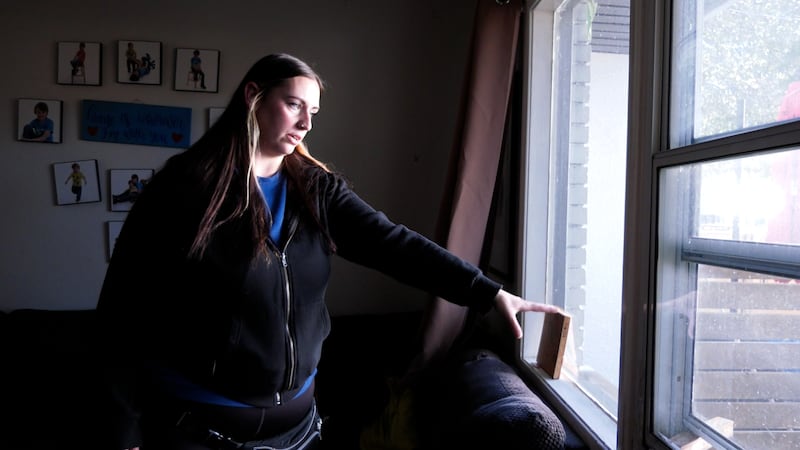
As Alberta’s teachers’ strike stretches into its fourth day, advocates for children with disabilities worry they’re being left behind — struggling to find care, maintain jobs and ensure their kids don’t lose critical learning progress while schools remain closed. Negotiations between the Alberta Teachers’ Association (ATA) and the provincial government aren’t set to resume until next week, leaving parents like Cochrane’s Michelle Godard-Richer in limbo. “Families with coded children in the system that are essentially needing extra support and are on an Individualized Personal Education Plan (IPP) haven’t really been considered with the teacher strike,” said Godard-Richer. Her 17-year-old daughter Victoria, a Grade 12 student, lives with Level 3 autism and requires one-on-one classroom support, but a lack of classroom resources and ongoing overcrowding in schools is making that a huge challenge. A lack of educational assistants is adding to the burden. “Special needs students are being put in a classroom with a teacher that’s trying to manage 30-plus other students at the same time. So, you’re seeing a lot of behavioral issues, outbursts, injuries, self injuring; it’s really not a good situation for children in schools,” she said. Outside of the classroom, Godard-Richer says the battle to receive essential support is even worse. “My husband works 56 hours per week so that I’m able to stay home right now and work part time, but a lot of other families aren’t so lucky,” she said. “They’re losing their income or worse, their jobs, just to take care of their kids.” “Families are also waiting two to three years for the Family Support for Children with Disabilities program (FSCD), so they’re not necessarily getting the speech and the occupational therapy they need. “It means by the time they even get to school, they don’t necessarily know how to communicate, they don’t know how to manage all the sensory information coming at them because they aren’t prepared.” Advocates call for sustainable classroom supports Organizations that support people with disabilities say the ongoing labour dispute highlights long-standing issues around inclusion and underfunding in Alberta schools. “I don’t know if we’ve ever seen it this bad,” said Trish Bowman, CEO of Inclusion Alberta. “We know that population growth has had a profound impact on our classrooms. We’re hearing about schools where the staff room has been converted into a classroom. I mean, you can hire more teachers but there’s not necessarily any place to put them, so we need creative solutions.” Bowman said many families of children with disabilities are already on edge from years of inconsistent supports — and a strike only amplifies those stresses. “Families can’t get the FSCD so we’re now compounding those problems outside the classroom with the lack of resources teachers have to handle this. The challenges for parents of special needs kids are so profound and $30 per day, won’t allow them to hire someone who has the skills to help them.” Bowman says she hopes that when contract talks resume, both sides will consider how classroom conditions affect the most vulnerable learners. “These students bring gifts and talents and joy to our classrooms and our neighbourhoods, so it’s a real loss when people can’t figure out how to make ends meet because we’re in a constant crisis.” Teachers urge government to act as strike continues The Alberta Teachers’ Association says it’s hopeful formal bargaining will resume next week after exploratory discussions in recent days. In a press release Thursday, the ATA said it has initiated a formal bargaining meeting with the Teachers’ Employer Bargaining Association and a mediator for Tuesday, Oct. 14. “We are unable to provide further details,” the statement read. In a statement to CTV News, Finance Minister Nate Horner confirmed that both sides will return to the table next week. “The ATA finally responded to TEBA’s invitation to get back to the bargaining table and the two parties will be sitting down for formal bargaining talks with the mediator next Tuesday,” Horner said. “Alberta’s government is hopeful that the ATA’s proposal to TEBA is reasonable, fair and adequately represents the terms that teachers want to see reflected in their deal. “We are focused on securing a deal that is fair to teachers, students and Alberta’s taxpayers.” Until Tuesday’s bargaining talks, the government says it has no further comment. The ATA also released new international findings this week showing Alberta teachers are facing among the highest stress levels and workloads in the world. According to the Teaching and Learning International Survey (TALIS) 2024 — an Organisation for Economic Co-operation and Development (OECD) study conducted in more than 50 countries — 42 per cent of Alberta teachers reported experiencing stress “a lot” in their work, the highest rate among all participating jurisdictions. The report also found Alberta teachers work an average of 47 hours per week, ranking among the top globally and about five hours more than the international average. ATA president Jason Schilling said the data reinforces what teachers have been reporting for years. “Much of the data in this report confirms what our own research has been telling us for years: Alberta teachers are feeling stressed out, overworked and underappreciated by government,” Schilling said. “Without urgent changes, teaching is quickly becoming a career that is unsustainable for many, despite their passion for teaching and supporting students.” The TALIS report also found Alberta teachers have seen the steepest drop among OECD countries in how valued they feel by policymakers, with only 13 per cent now believing their views are respected by government — a decline of 25 percentage points since 2018. The ATA, which represents 51,000 teachers across the province, says it continues to advocate for improvements to classroom supports and conditions, especially for students with complex needs.