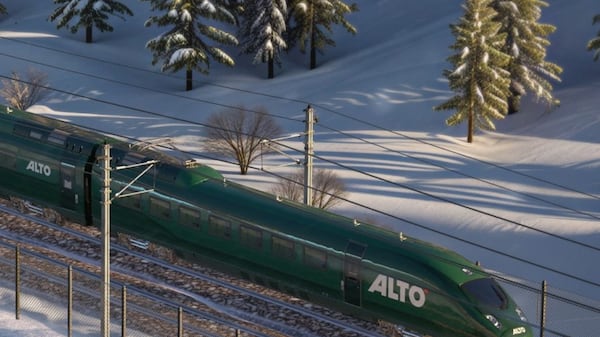
Transport Minister Steven MacKinnon on Tuesday defended new land seizure powers proposed for a high-speed rail project between Toronto and Quebec City. Detailed in draft legislation, the enhanced expropriation abilities would allow Ottawa to fast-track processes that could otherwise become bogged down “for 10, 12, 15 years,” he said. “There is no removal of due process,” he told reporters twice en route to a cabinet meeting in Ottawa. “This is going to be a bespoke regime. It’s been used in Ontario, it’s been used in Quebec for public transit projects. It’s an extremely important component of this project and it’s one that we’re very comfortable with.” The comments came after the federal government spelled out in a 519-page procedural motion on Friday measures that would expand its power to lock down property rights along the rail corridor. Those rights include allowing seizure of land for transfer to a private consortium — like the one contracted to build the line — broader discretion to bar work on a given lot and sending disputes over road crossings to private arbitration, which could see farmers foot part of the bill for construction and maintenance. The move builds on the High-Speed Rail Network Act passed earlier this year that enabled the government to sidestep purchase negotiations, expropriate land without public hearings and secure the first right to buy a property for up to eight years, without fronting the cash to the owner. Ontario Conservative MP Michael Barrett said the latest changes would replace the existing Expropriation Act with a separate regime for high-speed rail, compounding concerns about cost and disruption to rural communities in eastern Ontario and Quebec. “Residents are deeply concerned about the potential loss of homes and farmland, disruption to local businesses and lasting damage to our environment,” he said in a public letter to MacKinnon on Tuesday. Barrett singled out the dispute resolution provisions, stating that farmers and municipalities could face arbitration costs of up to $25,000 on top of their own legal fees. Locals have also voiced worries that the walled-off track will block country roads and create longer, bottleneck-prone drives for commuters and first responders, as the high train speeds rule out at-grade crossings. NDP Leader Avi Lewis criticized project’s public-private ownership model and said smaller communities feel excluded and “insufficiently consulted.” “You really need the social licence for big projects because any railway — it’s got to take somebody’s land,” he said. “We need the most transparent and democratic process to do that. And when you’re in a P3, you just don’t get that.” The high-speed rail project would see trains running between Toronto and Quebec City at a projected cost of between $60 billion and $90 billion. Alto, the Crown corporation overseeing the project, is weighing two possible corridors for eastern Ontario. One traces a direct line between Ottawa and Peterborough and the other arcs along a more southerly path, with Kingston as a stop under consideration. Construction of the first phase of the 1,000-kilometre rail line is set to kick off in 2029 or 2030, linking Montreal and Ottawa in an effective test case for what would be a massive infrastructure project intended to transform rail travel in Canada’s most densely populated region. The seven stops mandated so far by the federal government are: Toronto, Peterborough, Ottawa, Laval, Que., Montreal, Trois-Rivières, Que., and Quebec City. Alto has said the benefits of the project range from greater economic output, job growth and tourism revenue to emissions reduction and safer travel. It has pledged to support local economies by hiring workers and buying materials from those areas during construction. The proposed network would host 72 trains a day running on dedicated electric tracks at 300 km/h, slashing current travel times. It would make for a three-hour trip between Toronto and Montreal and less than one hour between Montreal and Ottawa. Alto CEO Martin Imbleau has acknowledged that some expropriations will be necessary, though he declined to give an estimate. The Montreal-Ottawa leg would cross some 1,700 properties, including about 500 agricultural ones, he said earlier this year. --- Christopher Reynolds, The Canadian Press This report by The Canadian Press was first published Nov. 24, 2026.