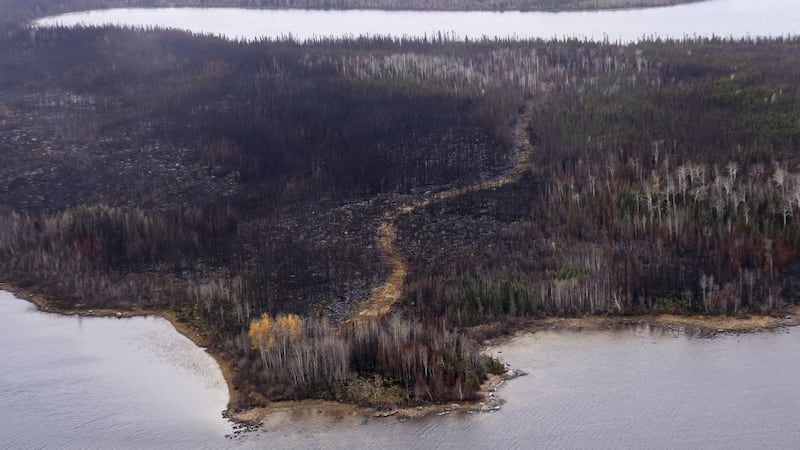
After more than doubling in size on Sunday, the out-of-control wildfire in West Dalhousie, N.S., grew again on Monday – from 7,780 hectares to 8,026 hectares. The Department of Natural Resources (DNR) says the Long Lake wildfire, which first started on Aug. 13, has now advanced along both sides of Paradise Lake, despite some rainfall Monday. “Yesterday we had a little bit of rain, which was wonderful, so our crews did not have to respond to any (new) wildfire incidents yesterday,” said Jim Rudderham, director of fleet and forest protection for DNR, during a news conference Tuesday afternoon. “It’s still not enough rain, even in the places that got the most rain, to significantly wet the province to make it better to even think about lifting any of the restrictions or bans right now.” DNR says crews are focusing on the east side of Paradise Lake as they try to prevent the fire from spreading to Trout Lake. They also continue to build guards in an effort to contain the perimeter north of West Dalhousie Road. “This fire has grown and given the drought conditions in this province, we are very well aware … that this is going to be a long incident,” said Rudderham. DNR says there are six other wildfires burning in the province, but they are all under control. More help coming to give N.S. crews a break Tuesday’s resources in West Dalhousie included the following: DNR says another 20-person crew is coming from Ontario on Wednesday to replace a 20-person crew from Nova Scotia. An incident management team is also coming from Ontario to allow the incident management team in Nova Scotia to take a break. “Our crews definitely need a rest,” said Rudderham. “This will give us some time to get a little bit of rest, because they have been going flat out for much longer than this incident has been going on, because they’ve been trying to protect our province for a long time from other fires.” DNR says there have been no serious injuries due to the wildfires and firefighters are being offered mental health support. Still assessing damage to homes The province confirmed Monday that a number of homes were damaged by the fire as it intensified and jumped dozer guards over the weekend. Officials said Tuesday they are still assessing the damage, and fire activity along the northern border is making it challenging to do a thorough assessment, so they are unable to say how many homes have been damaged at this time. They say they also want to inform all the families whose homes have been damaged before releasing any official numbers. A provincially-owned communications tower in the area is still standing and functioning, officials confirmed Monday, thanks in part to efforts from structural protection crews. 330 homes evacuated The province said about 330 homes had been evacuated due to the Long Lake wildfires as of Monday. The first two evacuation orders were issued on Aug. 14 for residents in the West Dalhousie Road area. More evacuations were ordered Sunday afternoon and again Sunday night as the fire spread. Luanne Isnor, her partner, and their four pets were forced to evacuate their Trout Lake home in New Albany on Sunday. Isnor says she was anticipating an evacuation alert on her phone. “We had most of our things already packed prior to and we just grabbed our animals, our two cats and dogs,” she told CTV News. As the fire drew closer, she says the emotional weight of leaving their home was overwhelming. “It’s something that’s really hard to put into words,” says Isnor, who is staying with relatives. “It’s just a feeling of no control and not knowing what might happen. If we’re going to have a home to come back to or not … if we’re saying goodbye to our lake.” All evacuees are urged to register online or at the evacuation reception centre and shelter at the NSCC campus on Commercial Street in Middleton, N.S. “Registration ensures we can account for everyone’s safety and determine if you require overnight accommodation,” said the Municipality of the County of Annapolis in a statement. Residents with questions about the West Dalhousie wildfire or evacuation process can call 1-833-806-1515. The Nova Scotia government has announced emergency funding to help evacuees. Wildfire affecting mail delivery Canada Post says the wildfires are affecting mail and parcel delivery in some communities in Annapolis County so a pick-up option is now available for some customers. Customers with the postal code B0S 1C0 can pick up their mail at the Bridgetown post office on Court Street. Customers with the postal code B0S 1P0 can pick up their mail at the Middleton post office on Main Street. Residents must bring a valid government-issued photo ID to pick up their mail. Residents and businesses impacted by the wildfires can also receive a free mail-forwarding service for up to 12 months. They can register for the service online or at a post office until Sept. 22. Air quality statements expand in N.S. An air quality warning remains in effect in Annapolis County, where the smoke is significantly reducing air quality. Air quality statements have also expanded to the following areas: “Smoke from a wildfire near the Long Lake area of Annapolis County will reduce air quality downwind. Smoke conditions may vary locally as wind and fire behaviour changes,” said Environment Canada in a statement. “Air quality is already being reduced in Lunenburg County with reductions expected in some parts of Halifax County this morning before the smoke plumes settles into Kings and Hants counties this afternoon following the anticipated windshift.” Residents are advised to keep their doors and windows closed and limit time spent outdoors. For more Nova Scotia news, visit our dedicated provincial page