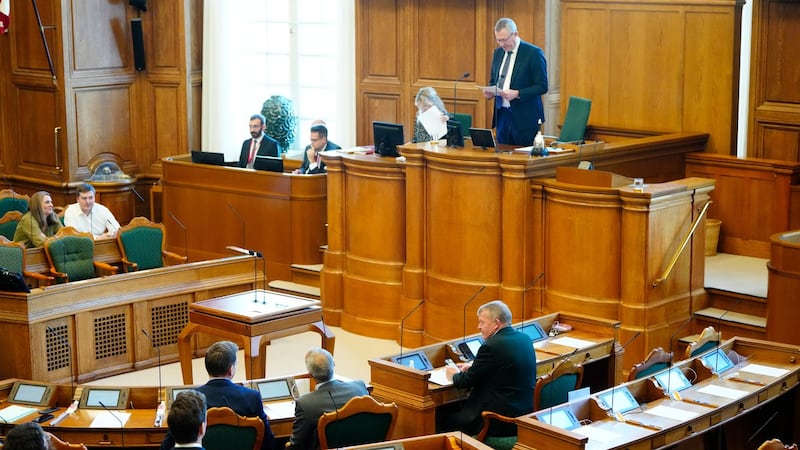
Some of the biggest players in housing and development met under one roof in Halifax on Thursday to discuss some of the biggest barriers to solving the housing crisis. “Green Acres, which is under construction right now, took us 10 years to get an approval,” said Marc Ouellet, the director of land development at Armco Capital Inc. The event, the National Day of Housing Summit at the Halifax Marriott Harbourfront Hotel, saw two key themes emerge: a lack of shared vision among politicians, and a shortage of infrastructure to support growth. “All levels of government need to get together to improve the infrastructure situation, for one. Roads, transit, things like that, are in deficit,” said Chris Marchand, the Canadian Home Builders’ Association Nova Scotia president. “We also need more available land to build on.” Two of the biggest developers – Armco Capital and Clayton Developments – shared their frustration and realities of the bureaucracy. Ten-year approval concerns “The impact to the home builders and to our, ultimately, customer is 10 years of carrying cost, directly passed along to the consumer,” said Kevin Neatt, Clayton Developments Ltd. vice president, planning and development. “Unfortunately, you have to do a business.” Referring to the Green Acres development, Ouellet said it’s an as-of-right subdivision, meaning it didn’t require special council approval. “(It) took us 10 years because engineering kept changing the rules on us,” he told the audience. “A few years ago, we stopped purchasing lands in the HRM,” Ouellet explained. “We’re not acquiring more lands because we don’t need more lands that we cannot develop.” While the Nova Scotia Association of Realtors says rental availability is right, more variety is sorely needed. “We need more non-market housing, we need more smaller housing, more affordable housing or attainable housing for the consumer of today,” Roger Boutilier, the CEO, said in an interview with CTV News. Not ‘remotely ready’ for future: expert The Canada Mortgage and Housing Corporation (CMHC) called out population trends in the last five years. Kelvin Ndoro, the housing economics and insights lead economist, said Nova Scotia’s population has increased by about 104,000 over that time. “That is about 21,000 people per year, compared to the previous decades, where we were increasing about 3,000 people per year,” he said. He described a population decrease more recently, but with a large focus on defence spending, some are fearful of what’s next. “I don’t believe we’re learning from the cities who have grown before us,” Dan Monk, owner of Monk Renovations, said in an interview. “We’re looking to grow our city. We have major defence contract spending going to go on here in the province, or in Halifax, in particular. “I don’t think we’re even remotely ready for it.” State of housing Marchand calls the state of housing in the province “uneasy” and “unsure.” “I think low-rise home builders are unsure of what to think of right now,” he says. “The housing market is slow on the customer side, but we keep hearing announcements about investment that’s going to take place in Nova Scotia. “So, we’re hopeful that these investments come through and it turns around the housing industry.” In an interview, he referenced Calgary and Edmonton as examples where it takes “a matter of weeks instead of years” to build subdivisions. “The infrastructure to do that is being provided upfront so that the developers just connect to it.” But he says defence promises and energy projects, like Wind West, are reasons for hope in Nova Scotia. For more Nova Scotia news, visit our dedicated provincial page