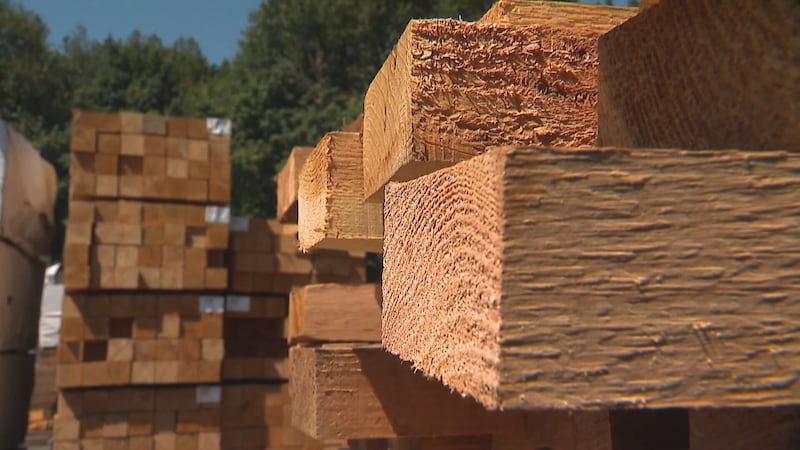
The next time New Brunswick wood producers ship their softwood lumber down to the United States, they will save a few more dollars than they did a year ago. According to information on the Government of British Columbia’s website a recent review of countervailing and anti-dumping duties by the U.S. Department of Commerce will mean softwood lumber exporters will now be faced with a near 35 per cent tariff. That is down from 45 per cent that forestry officials have been managing for the past year. While some wood products vary slightly, for the most part anti-dumping duties now sit at 10.64 per cent, while countervailing duties are at 14.11 per cent for a total of 24.75 per cent of added costs. When adding the additional 10 per cent tariff U.S. President Donald Trump implemented on all wood and lumber products levied under the grounds of national security, New Brunswick softwood lumber exporters are now paying just below 35 per cent of import taxes to send their goods south of the border. According to the government’s website, the forestry industry is a significant driver of the provinces economy contributing around $1.5 billion annual to New Brunswick’s gross domestic product (GDP). The sector also employs more than 25,000 direct and spin-off jobs for New Brunswickers. CTV Atlantic reached out to Jerome Pellieter, chair of the New Brunswick Lumber Producers Association and is waiting a response. In a statement to CTV, New Brunswick’s Natural Resources Minister John Herron says while the reduced tariffs will provide some relief for the industry, duty rates remain “extremely” high. “The Government of New Brunswick is disappointed that the U.S. continues to impose these unfair duties and tariffs on Canadian softwood lumber products,” Herron says in his statement, “New Brunswick continues to advocate for a trade deal between Canada and the U.S. that includes softwood lumber and provides the predictability and stability that our softwood lumber industry requires to continue to trade with the U.S.” The Minister also highlighted that the royalty rate charged for softwood logs that come from New Brunswick crown land are set on the basis of fair market value seen in private transactions and then adjusted to reflect market conditions. He says the sector is still facing challenging market conditions, most evident by the recent idling of the AV Nackawic mill. “The Department of Natural Resources sets Crown timber royalty rates monthly and when prices are calculated for November, they will be based on the four-week average from October. If lumber transactions change this month, the royalty rate for softwood logs will begin to increase.” The New Brunswick Federation of Woodlot Owners says any reduction on tariffs is good news for the industry, and hopes the recent reduction is a sign for things to come. President Rick Doucett says the 10 per cent tariff reduction should help provide more stability for industry officials. However, he says it’s too early to tell if it will translate to better wood prices for woodlot owners. “We often share in the bad times, but we don’t necessarily share in the good times,” Doucett says. “The amount of public wood that’s available [for mills] and the access that buyers have to resources makes it very difficult to get a fair market price for wood.” Doucett says a very small percentage of New Brunswick’s harvested lumber stays in the province, with much of it being shipped to markets in the U.S. He also says the news won’t change day-to-day life for most woodlot owners as he says people still are going out into the woods regardless of the tariff circumstances, but notes a lot more good news is needed to see the province’s forestry sector return to full capacity. “I think all woodland owners and all wood producers would like to get back to a situation that New Brunswick enjoyed for quite some time, which was a total exemption on tariffs on softwood lumber,” says Doucett. “That’s going to require quite a bit of negotiation and probably quite a bit of effort.” Doucett admits getting a deal like that with the current administration in Washington is unlikely. “The challenge has always been, can we keep our people that work in the woods employed and making money, and that’s becoming less and less likely.” For more New Brunswick news, visit our dedicated provincial page.