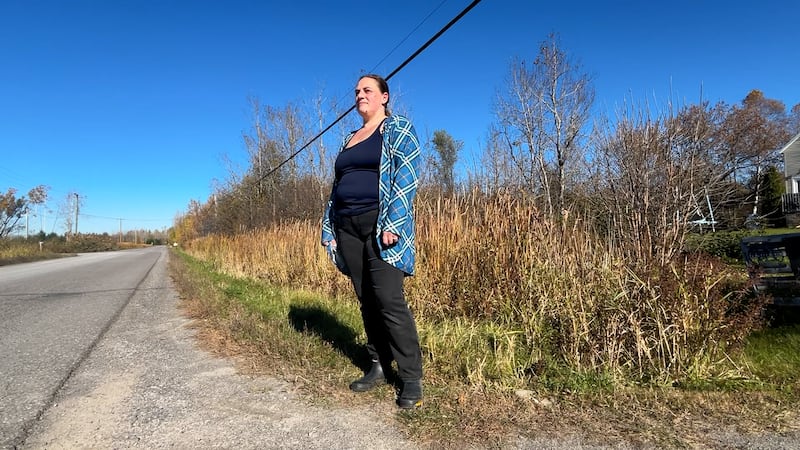
Linda Bell says there has been turmoil and chaos along parts of the United States and New Brunswick border as trucks carrying lumber navigate the new tariffs that came into effect on Tuesday. A new 10 per cent tariff was placed on softwood lumber on top of the existing 35 per cent. There’s also a new 25 per cent tariff on some finished wood products, like cabinets and furniture. But Bell says there’s been confusion as to what’s included under the new tariffs. In her almost three decades working as the general manager of the Carleton Victoria Wood Producers Association in Florenceville, she says it’s the first time there appears to be a duty on roundwood. “Trucks that were headed over there have been turned back and had to be unloaded. Some have been allowed to cross. We really don’t know what is going on,” she said. “I told a trucker today, you know, he should not go is what we were hearing. But he went and got across.” She said a few large mills in Maine who’ve been buying New Brunswick wood for five decades have halted all deliveries until the confusion can be cleared up. “If the demand is not there from the States, it’s going to have a very poor effect on us, that’s for sure,” Bell said. During a meeting with business leaders in Fredericton, federal Industry Minister Mélanie Joly said there are different interpretations happening at various border locations. “We’re seeing also that the interpretation sometimes of executive orders coming out of the White House are not the same, depending on the border agents in the U.S.,” Joly told reporters. “This is something definitely that Minister (Dominic) LeBlanc is working on and that we will be able to, provide more clarity as we’re engaging even more with the U.S. administration.” Bell also mentioned that many products – even wood that is not tariffed – are now required to undergo a formal entry, the administrative process goods worth $2,500 or more have to undergo when crossing the border. It usually requires a customs broker. “Previously, because the loads were worth $2,500 or less U.S., all they had to do was to give a manifest to the border and it was a simple entry, but it sounds like some borders are saying that we’re going to have to go with the formal entry,” she said. “Some have still let trucks go through without it. I don’t know. It seems to be, nobody really seems to know all the answers, I guess. So it’s a lot of turmoil.” James McKenna, president of Glenwood Kitchen in Shediac, says it has felt like the 25 per cent tariff on cabinets came out of nowhere. McKenna says his company has a strong relationship with his U.S. customers – a relationship that stems from the historical ties between New Brunswick and the New England states. “As far as we’re hearing, they still want to buy Canadian products. They don’t agree with President Trump and to them this is more of a burden and a nuisance and they want to work through it with us,” he said. He says it will mean the two sides have to work together on what that means for pricing. “It’s going to take a hit in my profitability, a hit in their profitability, to ensure that the consumers keep buying from them. That’s at 25 per cent. At 50 per cent is not doable. There’s no way that anybody can afford a 50 per cent tariff on their product.” President Donald Trump has said the 25 per cent tariff will increase to 50 per cent on Jan. 1. McKenna says his job has become entirely focused on the tariff situation – and how to find more customers outside the U.S. “We’re doing all kinds of things, really in sales mode to regain the business that we’re going to lose,” he said. For more New Brunswick news, visit our dedicated provincial page.